
The Mind Behind BigBasket: What I Learned From K Ganesh About Loyalty, Super Apps, and Brand Building
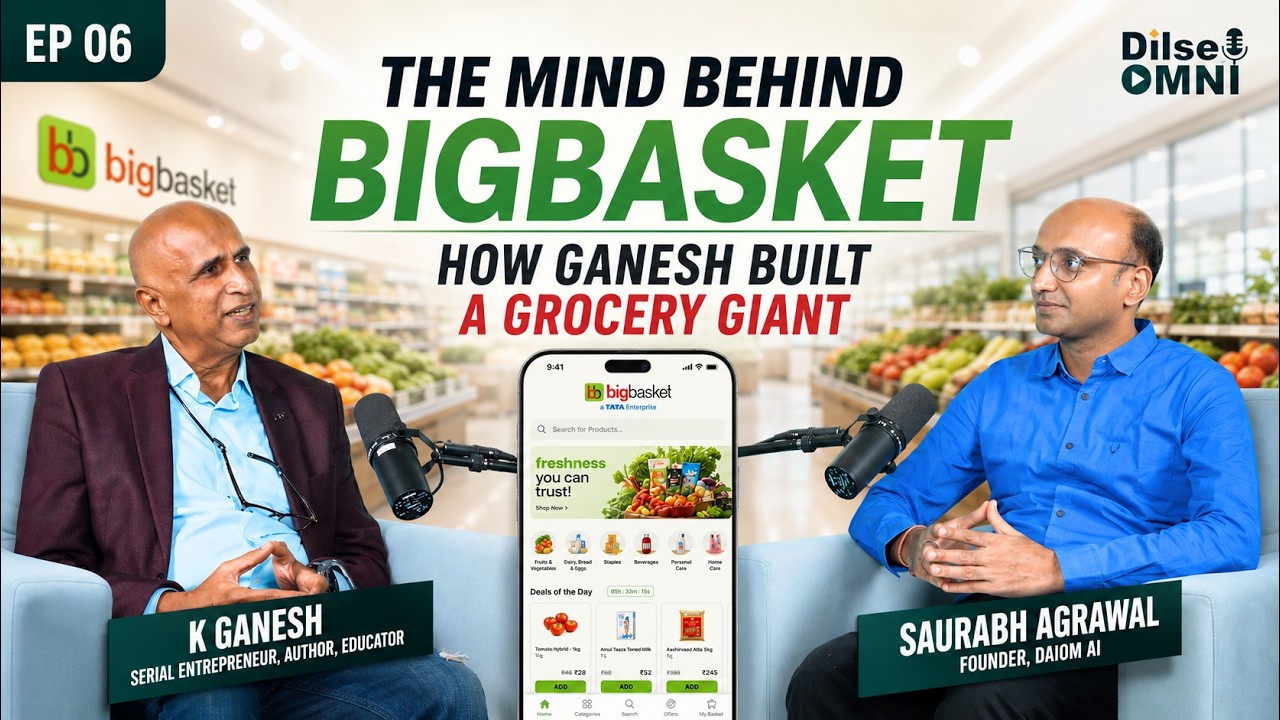
I have used BigBasket often enough to know what trust in grocery really feels like. When a platform becomes part of your monthly rhythm, you stop thinking of it as an app and start treating it like dependable infrastructure. That is why my conversation with K Ganesh felt less like a podcast exchange and more like a masterclass in how enduring consumer businesses are actually built.
About the Guest: K Ganesh is a seasoned serial entrepreneur and promoter of several successful startups through his venture factory, Growth Story. He is widely recognized for his ability to scale businesses in the edtech, grocery, and healthcare sectors.
What struck me in this conversation was not just his understanding of BigBasket, Tata, loyalty, and super apps. It was the clarity with which he separated good business theory from messy business reality. That distinction matters. In boardrooms, many ideas sound elegant. In the market, only a few survive customer behavior, shareholder complexity, unit economics, and execution friction.
If there is one lesson I carried back from this discussion, it is this:
"A concept can be brilliant and still fail if it does not create real customer value."
Table of Contents
- Why BigBasket Became a Habit, Not Just a Service
- The Big Question: Can Loyalty Programs Unite Different Businesses?
- Why a Group Like Reliance May Have a Simpler Path Than Tata
- Brand Awareness Is the Easy Part. Value Delivery Is the Hard Part.
- Why Super Apps Sound Better Than They Often Feel
- What Makes Tata Neu Attractive Anyway?
- Is It Creating New Value or Just Redirecting Existing Spend?
- The Payback Lesson: Coalition Loyalty Is Not New
- What Entrepreneurs Can Learn From the BigBasket Journey
- My Biggest Takeaway From K Ganesh
- Closing Thought
Why BigBasket Became a Habit, Not Just a Service
One of the simplest indicators of product market fit is repeat behavior. In categories like grocery, frequency matters more than flash. People do not want excitement from their grocery platform. They want reliability, relevance, and ease.
That is one of the biggest lessons from the BigBasket journey. Grocery is a low margin, high frequency business. You cannot win it with branding alone. You need the fundamentals to work repeatedly:
- The assortment has to feel complete.
- The customer has to trust the quality.
- The delivery promise has to be believable.
- The experience has to save time, not add effort.
That is what separates a curiosity from a habit. BigBasket did not grow because online grocery was fashionable. It grew because it solved a recurring pain point in a category people revisit constantly.
For anyone building omnichannel businesses, this is a powerful reminder. The strongest brands in everyday commerce are rarely built on novelty. They are built on consistency.
The Big Question: Can Loyalty Programs Unite Different Businesses?
A large part of my discussion with Ganesh centered on a question many retail and digital leaders ask today: can a group with many brands truly create one shared loyalty program, one data layer, and eventually a super app?
Tata is a fascinating case study because it has scale, trust, category breadth, and strong brands. But it also has structural complexity. Different companies sit under the group, many with different shareholders, joint venture structures, and independent interests.
That means you cannot casually pool customer data across businesses.
Ganesh made a very important point here. Shared data becomes possible only when the customer explicitly permits it. That is where a coalition loyalty program enters. If a customer signs up and consents, then the group can begin creating a more unified understanding of that customer across participating brands.
That may sound obvious, but it has profound implications. In large groups, the problem is not only technical integration. It is also governance, incentives, and consent.
"Customer data cannot simply be merged because the brands belong to the same group. The customer has to opt in."
This is the first major framework I took away from the conversation.
A Practical Framework for Coalition Loyalty
- Consent: The customer must agree to share identity and behavior across brands.
- Coordination: Participating businesses must align on value exchange and access.
- Compensation: Stakeholders must feel fairly rewarded for the data and business they contribute.
- Customer Value: The program must give the user a reason to care beyond internal strategy.
If even one of these breaks, the loyalty engine weakens.
Why a Group Like Reliance May Have a Simpler Path Than Tata
Another nuanced idea Ganesh shared was that not all conglomerates face the same level of difficulty. A more tightly controlled retail structure has a cleaner path to one unified program. A group with many listed companies, multiple shareholders, and separate governance layers has a much harder coordination problem.
That means the challenge is not only building the app or the loyalty mechanics. It is aligning commercial logic.
Every participating business asks its own questions:
- What do we gain from sharing customer information?
- How do we measure attribution?
- Who owns the customer relationship?
- How should rewards and economics be distributed?
These are not minor details. They determine whether the ecosystem works or becomes a patchwork of partially connected brands.
Brand Awareness Is the Easy Part. Value Delivery Is the Hard Part.
One of the sharpest observations in our exchange was around how much money can get spent on making a loyalty ecosystem famous before proving that it is truly effective.
Tata Neu is a strong example of this tension. On one hand, it has achieved significant awareness. Heavy brand investments, including large properties like IPL sponsorships and broad media visibility, ensure that people know the platform exists. From a pure top of funnel standpoint, that is powerful.
And this matters. Brand awareness is not superficial in omnichannel commerce. It lowers friction in trial. It creates recall at the point of purchase. It signals legitimacy. It can also make customers more willing to consolidate spend if they believe they are entering a meaningful ecosystem.
So yes, this kind of campaign absolutely helps drive awareness for participating brands like BigBasket. It reinforces the idea that BigBasket is not just a standalone grocery app but part of a larger, rewards connected consumption universe. That can lift familiarity, cross consideration, and repeat purchase.
But awareness alone is not enough.
Ganesh was candid that the bigger debate is whether the return justifies the branding spend, and whether the program creates incremental value or simply diverts spending that would have happened anyway.
"It is a great concept, but it has to deliver value."
That line stayed with me because it applies far beyond loyalty. Any brand can buy attention. Very few can convert that attention into durable, profitable behavior.
|
Why Super Apps Sound Better Than They Often Feel
Super apps are one of those ideas that executives love because they promise synergy. One place for commerce, payments, travel, healthcare, grocery, rewards, and identity. In theory, it is efficient. In practice, the customer experiences only one thing: how easy or difficult the journey feels.
That is where the model can start breaking.
Ganesh drew a useful contrast here. Some super apps feel integrated because their commerce layers are native to the experience. Others feel bolted together through APIs. When that happens, the customer journey can become clunky.
His example was especially relatable. If someone wants the reward points, they may begin shopping in one app, fill the cart there, then switch to the super app only to complete checkout and maximize points. That is not elegant behavior. That is workaround behavior.
And workarounds are dangerous signals. They mean the customer sees the reward, but not necessarily the platform design as intuitive.
A Simple Super App Test
Whenever evaluating a super app strategy, I now think about three layers:
- Discovery: Can I find what I want without confusion?
- Continuity: Does the journey flow naturally from browse to buy?
- Reward: Do the benefits feel like a bonus, not compensation for friction?
If the reward has to make up for a broken journey, the architecture is not yet doing its job.
What Makes Tata Neu Attractive Anyway?
It would be unfair to dismiss the model entirely, and Ganesh did not do that. In fact, he gave full credit to the ambition and scale of the attempt. Very few organizations in the world have even come close to trying a coalition loyalty system with this breadth.
There is also a genuine economic appeal for customers who already use multiple Tata services. If someone stays at Taj, flies with Air India, shops on BigBasket, or orders through Tata 1mg, the rewards can stack in meaningful ways. In such cases, groceries can feel cheaper because hospitality or travel spending feeds the same points universe.
This is where the model gets interesting. For a multi brand customer, the ecosystem can create very real utility.
But that brings us to the most important question of all.
Is It Creating New Value or Just Redirecting Existing Spend?
This, to me, was the heart of the conversation.
If a loyalty system pushes me to shift wallet share from one brand to another inside the same ecosystem, that may be useful for the group. But is it creating new customer value, new demand, or a better experience? Or is it simply moving my purchases around to capture them under one rewards umbrella?
That distinction matters because a business can look healthy on the surface while quietly subsidizing behavior it would have earned anyway.
Ganesh framed it as an open debate, and I think that honesty is refreshing. Too often in strategy conversations, leaders rush to declare big platform ideas successful before the deeper economics are visible.
"The real question is whether the system adds incremental value or merely diverts spend."
The Payback Lesson: Coalition Loyalty Is Not New
Another useful reference in the conversation was Payback, earlier known as iMint. That model brought together multiple brands under one coalition loyalty structure, including banking, telecom, and payments participants over time.
The significance of this example is simple. Coalition loyalty is not a fresh buzzword. The idea has existed before. It can work, but only under the right balance of utility, economics, and execution.
The history here offers two lessons:
- The model is viable enough to attract serious businesses.
- The model is fragile enough that ownership changes and strategic drift can weaken it.
So when we discuss modern ecosystem plays, it helps to remember that the hardest part is rarely inventing the concept. It is sustaining relevance.
What Entrepreneurs Can Learn From the BigBasket Journey
Even though this part of the conversation centered on Tata Neu, loyalty programs, and super apps, the entrepreneurial lessons from BigBasket were everywhere beneath the surface.
Here is the framework I came away with.
1. Solve recurring pain, not occasional excitement
BigBasket sits in a routine category. That is exactly why execution matters more than hype.
2. Build trust before you build ecosystems
A loyalty wrapper cannot rescue a weak core proposition. The base product has to stand on its own.
3. Customer consent is strategy, not legal paperwork
In the data driven era, permission is part of the business model.
4. Branding can accelerate awareness, but only value drives retention
Big campaigns can make a platform famous. They cannot make it indispensable.
5. Integration quality defines omnichannel success
If the journey is fragmented, the customer notices immediately, no matter how sophisticated the backend sounds in a presentation.
6. Measure incrementality honestly
The most dangerous growth story is one that mistakes redirected demand for newly created value.
My Biggest Takeaway From K Ganesh
I went into this conversation thinking primarily about super apps and shared loyalty. I came out thinking much more deeply about customer value architecture.
That is what seasoned entrepreneurs do. They simplify the noise. They bring the conversation back to first principles.
The first principle here is not whether a conglomerate can create one app, one rewards engine, or one data graph. The first principle is whether the customer feels a meaningful improvement in convenience, cost, trust, or experience.
If the answer is yes, ecosystems win.
If the answer is no, then even the best funded strategy starts feeling ornamental.
That is why BigBasket remains such an important business story. It reminds us that in commerce, especially omnichannel commerce, enduring value is built from the ground up. Technology matters. Brand matters. Loyalty matters. But none of them can replace genuine utility.
"Great concepts deserve credit. Great execution earns loyalty."
Closing Thought
For founders, operators, and marketers trying to decode the future of retail, the lesson is clear. Do not get hypnotized by the architecture alone. Ask what the customer gets, what friction disappears, what trust gets built, and what behavior truly changes.
That is the lens through which I now look at BigBasket, Tata Neu, coalition loyalty, and every super app conversation that follows.
I am Saurabh Agrawal and we come with a new episode on Dilse omni talks every fortnight and cover different aspect of omnichannel with amazing speakers.
This article was created from the video The mind behind @bigbasketofficial | Dilse Omni Talks