
The Question Every Student Should Ask Before Choosing College
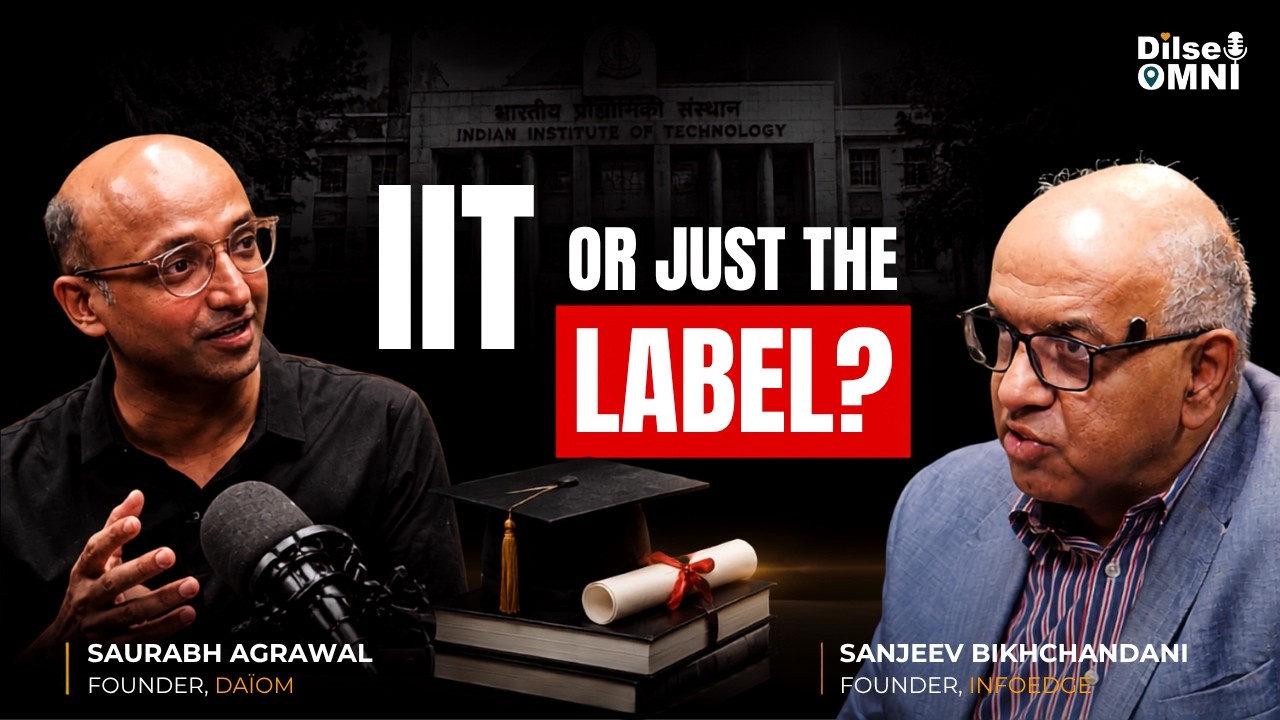
On Dilse Omni, I had the privilege of speaking with Padma Shri awardee Sanjeev Bikhchandani, founder of Info Edge, the company behind Naukri, 99acres, Jeevansathi, and Shiksha, and one of the early backers of Zomato, Policybazaar, and many deep tech and AI startups. But this conversation was not about startup valuations or investment theses. It was about a far more foundational question.
How do young people make one of the biggest decisions of their lives when they barely know themselves yet?
What struck me most was how personal the story behind Ashoka University really is. It did not begin as an abstract policy idea. It began with a young Sanjeev standing at a crucial fork in the road, forced to ask a disarmingly simple question that most students never pause to ask honestly.
"Why do I want IIT?"
That one question became the seed for a much larger critique of how India thinks about college, specialization, status, and careers. What followed in our conversation felt like a masterclass, not just in education, but in self-awareness.
Table of Contents
- Why Ashoka University Was Created
- The IIT Dream That Changed Everything
- "Did I Want Engineering or Just the IIT Brand?"
- How St. Stephen's Shaped His Thinking
- The Moment That Inspired Ashoka University
- Why India's Education System Needs to Change
- Why Students Should Choose Their Passion, Not Just Their Rank
- The Future of Education in the AI Era
Why Ashoka University Was Created
I opened by asking what inspired the creation of Ashoka University, and whether there was any influence from Western education systems. Sanjeev's answer was immediate and deeply autobiographical. Ashoka, he said, emerged from his own journey.
That matters. Many institutions are built around funding, policy, or ambition. This one was built around lived confusion. Around a moment of discomfort. Around the realization that the education system often asks 17 year olds to make decisions that even adults do not fully understand.
Ashoka was designed to address a structural flaw in Indian higher education. In our system, students often have to choose a stream or specialization too early. And very often, they are not really choosing. Their marks are choosing for them. Their rank is choosing for them. Social prestige is choosing for them.
Ashoka offered a different model. Enter first. Explore multiple disciplines. Decide your major later.
That is not just an administrative design choice. It is a philosophical one.
- First principle: young people need exposure before commitment.
- Second principle: identity should not be locked in by exam rank.
- Third principle: multidisciplinary learning produces better judgment.
As I listened, I realized this is not merely about liberal education. It is about giving students the right to discover themselves before being labeled forever.
The IIT Dream That Changed Everything
Sanjeev told me that when he finished school, he had qualified for IIT. That had been the dream. For so many middle class Indian families, IIT is not just an institution. It is aspiration, validation, certainty, mobility, and belonging all rolled into one.
Then came a medical test. He was told he was partially colorblind.
That diagnosis did not automatically shut the door. He could still join. But certain career paths and streams would close. It would remain on his record. For the first time, what had looked like a straightforward path suddenly carried visible risk.
And risk creates reflection.
Until that moment, IIT had been the obvious answer. But the instant it became less clean, less certain, less automatic, a deeper question surfaced. Was the dream actually engineering? Or was it something else hiding underneath?
I found that moment incredibly powerful because so many life decisions are never examined while they still feel safe. We question them only when friction appears. A rejection. A health issue. A financial constraint. A failed entrance exam. But perhaps that questioning should happen earlier.
Sometimes the interruption is the education.
The biggest shifts in life often begin not with confidence, but with pause.
"Did I Want Engineering or Just the IIT Brand?"
This was the sharpest moment of the entire conversation.
Sanjeev said that when he asked himself why he wanted to be an engineer, he arrived at an uncomfortable truth. He did not really want to be an engineer. He wanted to be an IITian.
That distinction is everything.
He was not chasing the discipline. He was chasing the brand, the tribe, the stamp, the legitimacy, the doors that would open later. In Hindi, he used the idea of the chhaapa, the label, the visible mark of excellence.
"I did not want to be an engineer. I wanted to be an IITian."
How many students today are making the same trade without admitting it to themselves?
There is no shame in wanting opportunity, network, or status. Those things matter in the real world. The problem begins when we confuse the wrapper with the substance. When the prestige of the institution becomes more important than the nature of the work one actually wants to do.
That insight also explains a lot of distorted choices in Indian education. Students chase the highest cutoff, not the deepest fit. Families optimize for reputation, not alignment. A branch is selected because of rank signaling, not curiosity. Then years later, many graduates migrate into completely different careers.
This is where I think Sanjeev offered a simple but profound diagnostic framework.
A 3 Question Framework Before Choosing College
- Do I want the subject? Am I genuinely interested in the work and ideas behind this field?
- Do I want the brand? Am I mainly drawn by status, network, and signaling value?
- Do I want the outcome? Am I choosing for employability, optionality, or family expectations?
None of these motives are fake. But clarity matters. Confusion between them causes regret.
|
How St. Stephen's Shaped His Thinking
After reconsidering IIT, Sanjeev joined St. Stephen's College and studied Economics. He described entering with some confusion, but he also emerged with a clear critique of the academic experience. In his view, the structure was too exam oriented. Too easy to coast through for much of the year and then concentrate effort near the end.
That comment may sound small, but it points to another deep issue in Indian higher education. Too often, institutions reward episodic performance rather than continuous intellectual engagement. You can survive the system without truly inhabiting it.
Life moved on. He worked, joined IIM Ahmedabad, became an entrepreneur, and built one of India's most consequential internet businesses. But the questions around higher education did not disappear.
Years later, St. Stephen's would again become central to his thinking, this time not as a student, but as an alumnus reacting to an institutional decision.
For readers interested in Sanjeev's larger journey as a founder and investor, I would also recommend The Father of Indian Startup Ecosystem, where many of these themes around judgment, patience, and institution building show up in a different context.
The Moment That Inspired Ashoka University
The immediate trigger came in 2007, when St. Stephen's College announced a 50 percent reservation structure with a very large gap in the interview cutoff between the open category and reserved category. Sanjeev explained that many alumni felt the scale of that gap would damage academic standards.
The details of that policy debate were one layer. The deeper consequence was another. The alumni appealed to the college authorities and got nowhere. At that point, the response shifted from protest to creation.
If an institution you care about cannot become what you believe it should be, build a new one.
That is when he spoke to Ashish Dhawan and the thought began to crystallize that perhaps it was time to start a new college, or rather, a new kind of university.
There was also a personal context running in parallel. His children were growing up. His daughter was around 14. He had started researching universities around the world. He had also visited and spoken at campuses in India and abroad. Exposure had broadened the benchmark.
That sequence is important:
- Personal dissatisfaction with premature specialization
- Institutional frustration with existing academic structures
- Global comparison with other university models
- Parental urgency as his own children approached college age
That is how ideas mature. Not from one event, but from layers of lived tension finally aligning.
Why India's Education System Needs to Change
One of Sanjeev's clearest arguments was that India inherited the British system, where students choose a subject early and study that specific discipline in college. The American model, by contrast, often allows students to study a range of subjects in the first two years before selecting a major.
His point was not that one country is superior in every way. His point was that timing of specialization matters enormously.
In India, we do have multidisciplinary universities in name. But as he put it so crisply, we often do not have multidisciplinary education in practice, because a student enters one discipline and remains confined to it.
"In India, you have multidisciplinary universities, but not multidisciplinary education."
That sentence stayed with me.
When a student is 17 or 18, what do they really know about chemical engineering versus mechanical engineering versus economics versus psychology versus computer science? Often, almost nothing beyond hearsay, cutoff trends, and coaching center narratives.
Yet the system asks for certainty.
This creates a design flaw with massive downstream consequences. Students are specializing before exploration. And once they are inside the system, changing course is difficult.
The Misallocation Problem
Sanjeev used a very practical example. A student may want computer science, but their rank does not get them that branch. So they take civil engineering because the institution is prestigious enough. Then after graduation, they end up in a software job anyway.
That means:
- The student did not truly study what they wanted.
- The engineering branch did not retain a committed practitioner.
- The labor market corrected what the education system misallocated.
He called this a misallocation of resources, and I think that is exactly right.
We often discuss education in moral or emotional terms. But there is also an economic inefficiency here. Human potential is being sorted through rank filters rather than informed choice.
Why Students Should Choose Their Passion, Not Just Their Rank
The most practical takeaway from this conversation is that rank should not become identity.
In many households, the college process is framed as a ladder. The higher the rank, the better the branch. The lower the branch, the more it is treated as compromise. But this logic hides a dangerous assumption: that a student's interests should bend around what the rank permits.
Sanjeev challenged that assumption.
Ashoka's answer was elegant. Join first. Study five or six subjects in the first two years. Then choose a major. This gives room for discovery, comparison, and intellectual maturity.
I would summarize his philosophy in a simple decision framework:
The Fit Over Rank Framework
- Explore broadly before locking into a field.
- Distinguish prestige from interest with brutal honesty.
- Optimize for long term engagement, not short term signaling.
- Preserve optionality when the future is uncertain.
That last point matters especially now. In a world where careers evolve quickly, the best educational choice may not be the one that looks most impressive on day one. It may be the one that keeps your mind flexible on day one thousand.
For anyone exploring more conversations like this, the full archive at Dilse Omni Talks with Saurabh Agrawal goes deep into the systems and choices that shape modern business and growth.
The Future of Education in the AI Era
When I asked about students graduating into the 2030 world, especially in the age of AI, Sanjeev was refreshingly honest. He did not pretend to know exactly what that future will look like. In fact, his answer carried the kind of humility I increasingly value in serious thinkers.
He essentially said: nobody really knows.
That may sound unsatisfying, but it is actually liberating. If the future is uncertain, then early over-specialization becomes even riskier. If job categories are shifting, if AI is rewriting workflows, if disciplines are colliding in unexpected ways, then what students need most is not rigid identity. They need adaptability.
The less certain the future, the more valuable broad thinking becomes.
That is why this conversation about Ashoka is larger than one university. It is really a conversation about preparing young people for ambiguity.
What survives technological change?
- The ability to learn across domains
- The capacity to ask better questions
- The confidence to rethink old assumptions
- The wisdom to separate external labels from internal calling
If I had to distill my biggest learning from Sanjeev into one line, it would be this:
Before choosing a college, ask not just where you want to get in, but who you are becoming by getting in there.
That is the real question. And perhaps the one every student, parent, and educator needs to sit with a little longer.
I am Saurabh Agrawal and we come with a new episode on Dilse omni talks every fortnight and cover different aspect of omnichannel with amazing speakers.
This article was created from the learnings from the video The Question Every Student Should Ask Before Choosing College | Sanjeev Bikhchandani.