How to Find the Perfect Product for Your Audience and Launch It Correctly

Creating a product that sells is not about guessing. It is about matching what your audience already wants with a clear, valuable offer, then launching in a way that gets people from interest to purchase. This guide walks through a practical process you can use to find a “winning” product idea, improve it with value stacking, and launch it with confidence.
Why “perfect product” is really a match between three things
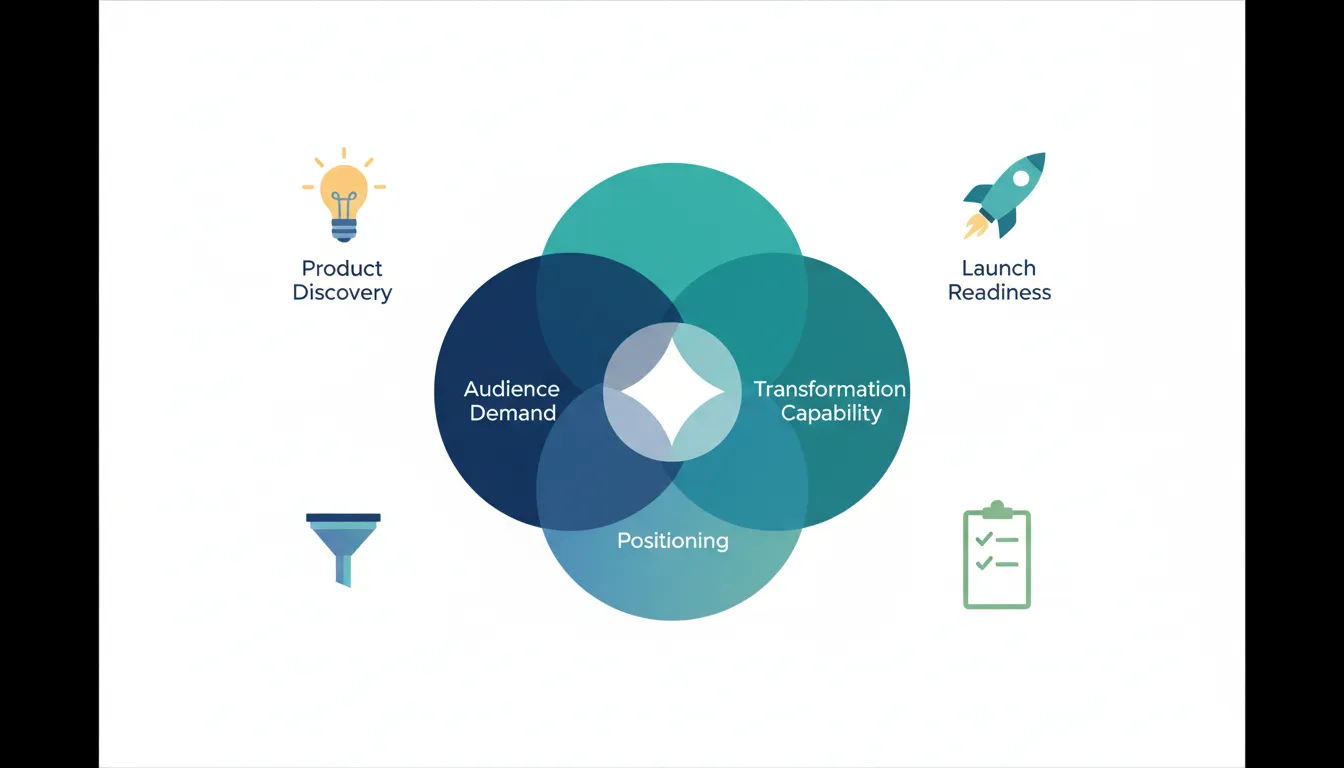
Most creators struggle because they treat product creation like an idea problem. It is also an audience problem and a positioning problem. A strong product is built from:
- Your audience’s existing demand (what they already watch, ask for, and buy)
- Your ability to deliver a transformation (what changes for them after they use it)
- Your offer clarity and value (why it is worth the price versus free alternatives)
If one of those is missing, sales will be inconsistent even if your product is “good” in theory.
Step 1: Find product ideas your audience is already asking for
Stop brainstorming in a vacuum. Use signals that your audience is already interested.
Use your most viewed (or top performing) content as your product blueprint
A reliable starting point is to turn what is already working into an offer that makes it easier for people to apply it. When viewers repeatedly show up for a topic, they are telling you what they want solved.
Action checklist:
- List your top 10 videos or posts by views and engagement
- Identify the repeated theme (the “bucket” topic)
- Write one product outcome for each theme (for example: plans, templates, kits, guides, recipes, step-by-steps)
Pull product requests directly from comments and messages
Comments are not just feedback. They are product requirements. Ask questions that force specificity.
Examples of high-signal prompts:
- “If I made a guide around this, what would you want inside it?”
- “What is your biggest frustration with this topic right now?”
- “Would you prefer a quick starter or a complete step-by-step system?”
To avoid bias, test multiple options. Do not assume the first response is the winner. The goal is to discover what a larger group actually wants.
Run simple polls until your audience chooses for you
When you are deciding between product angles, polls help you validate quickly. Offer 3 choices plus an “other” option. Then look for patterns.
Tip: keep the language audience-friendly. Replace vague categories with specific outcomes.
Dig for audience clues by studying “who they are” and “how they talk”
Once you know your audience’s identity and constraints, product choices get easier. Look for:
- Common phrases they use
- Recurring pain points they mention
- Budget expectations and time limitations
Two creators can cover the same topic but need different product formats because their audience realities differ.
Step 2: Choose the right product format (digital vs physical)
Product format affects conversion, pricing, and how fast you can iterate.
Digital products: best for speed and scale
- Low ongoing costs after creation
- Easier to test with quick updates
- Ideal for niche-specific guidance like templates, guides, and bundles
Physical products: best when your audience values “something to hold”
- Higher friction (shipping, returns, inventory)
- Can flop harder if you misjudge demand
- Strong fit for tactile communities that want an item for routines or identity
Practical recommendation
If you are early or unsure, start digital. If later you learn that your audience specifically wants physical, expand with a format they actively request.
Step 3: Validate your product idea before you build everything
Validation reduces wasted time. You want evidence before investing heavily.
Analyze competitors, but avoid copying weak offers
Look for what others sell in your niche and notice what is not working. A great way to differentiate is to avoid:
- Overly generic products
- Confusing instructions
- Missing components your audience keeps asking for
Read reviews of similar products
Reviews reveal what people loved and what annoyed them. You can build your offer around those gaps.
What to extract from reviews:
- Top complaints
- What buyers wished included
- Where users got stuck
- Who the product was actually made for (and who it was not)
Assess your audience’s “budget reality”
Pricing mismatch kills conversion. If your content uses budget signals or emphasizes affordability, your audience likely needs a price point they can justify quickly.
Simple rule: if your first attempt at a product is priced where your audience cannot realistically say “yes,” sales will not reflect product quality. It will reflect pricing fit.
Step 4: Add value with “value stacking” so people say yes
People do not pay for features. They pay for outcomes. Your job is to make the offer feel complete and easy to act on.
Start with one core transformation
Every winning product has a main promise. For example: “Help you plan meals faster” or “Show you how to get consistent results step by step.” Keep this promise clear.
Then stack additional helpful assets
Value stacking means bundling the core with supporting pieces that reduce friction. Common add-ons include:
- Checklists and cheat sheets
- Templates and fill-in-the-blank workbooks
- Shopping lists or resource lists
- Short starter guides
- Step-by-step instructions or beginner walkthroughs
- Examples, variations, and “what to do next” sections
Why it works: it turns “I kind of want this” into “This is worth it, and I know exactly how to use it.”
Step 5: Launch correctly using an email-first approach
Launching is not just posting. It is a sequence that moves people from awareness to action, and the most controllable channel is email or texting.
Build and actively use your email (or texting) list
Collecting contacts is only useful if you communicate consistently. If people forget you, conversion drops.
- Create an email or texting system
- Send helpful updates before the launch so trust builds
- Use the list as your “launch engine”
Create a small lead-in offer to grow the list
A simple strategy is to offer a free or low-cost digital item that matches the topic of your main product. This gives you a way to collect contacts from people who are already interested.
Examples of lead-in offers:
- A mini guide or quick-start PDF related to the main topic
- A starter template or checklist
- A recipe collection starter set
- A short “first steps” workbook
Key principle: make the lead-in directly relevant to the main purchase, so your email list becomes “pre-qualified.”
Use a landing page that sells your whole offer stack
Instead of sending traffic to a random page, send it to a sales-focused landing page. Include:
- What the core product is
- What is included in the value stack
- Who it is for
- Why it is a good deal at your price
- Clear call to action
The goal is to let the page do the selling so you are not repeating the same pitch everywhere.
Step 6: Plan your launch content so it holds attention
Many launches fail because they are all hype and not enough structure. A better launch content strategy keeps energy high and cycles through what the audience needs.
Use a repeatable format for live or long-form launch days
A strong pattern for launch content often includes:
- Make people feel seen (name prompts, quick questions, direct callouts)
- Give away value continuously (answer questions, show how the product works)
- Run giveaways strategically to boost participation
- Entertain in a way your niche enjoys (demo, behind-the-scenes, or topic-relevant segments)
- Remind people of the offer stack and give a clear buy message
Repeating the cycle helps because it keeps attention from draining while still driving toward purchase.
Step 7: Use social and content to extend the launch (not just the launch day)
Your biggest sales can come after the main announcement. Social content after launch keeps momentum alive, reaches people who missed the initial push, and reinforces the offer.
Practical posting rhythm:
- Pre-launch: warm up the audience with topic-related value and “what is coming” teasers
- Launch day: announcement plus urgency and clear next step
- Post-launch: keep posting product benefits, FAQs, and results-focused clips
Common mistakes to avoid
Building something nobody specifically asked for
If the product is based on guesswork instead of audience demand signals, it will be harder to sell even with good marketing.
Pricing too high for your audience’s buying behavior
Even a great product needs a price point the audience can justify quickly.
Under-stacking the offer
“I made a guide” is rarely enough. People need clarity on what they get and how to use it.
Launching without a list or without active communication
Posting everywhere and hoping is exhausting and often inefficient. Email or texting helps you control delivery.
Only promoting once
Conversion is iterative. People need repeated exposure plus a reason to act now.
Quick product discovery and launch checklist
- Pick your topic: start with a theme from your top-performing content
- Validate demand: mine comments, run polls, review questions
- Choose format: digital first unless your audience explicitly wants physical
- Research competitors: find what fails in reviews and complaints
- Define the transformation: one clear outcome for buyers
- Value stack: bundle assets that reduce friction and increase usefulness
- Build list: create a small lead-in offer
- Create a landing page: include the full offer stack and call to action
- Launch with structure: repeatable attention flow and clear reminders
- Extend post-launch: keep reinforcing benefits and FAQs on social and email
Conclusion: how to consistently find and launch winning offers
The “perfect product” is not accidental. It is the result of disciplined audience research, a clear transformation, and an offer that feels irresistible because it is complete and easy to use. Once you validate the idea and stack value, launching becomes less stressful because you already know who the product is for and why it matters.


