How to Grow a YouTube Channel in 2025: Content Strategy, Monetization, and Smarter Production

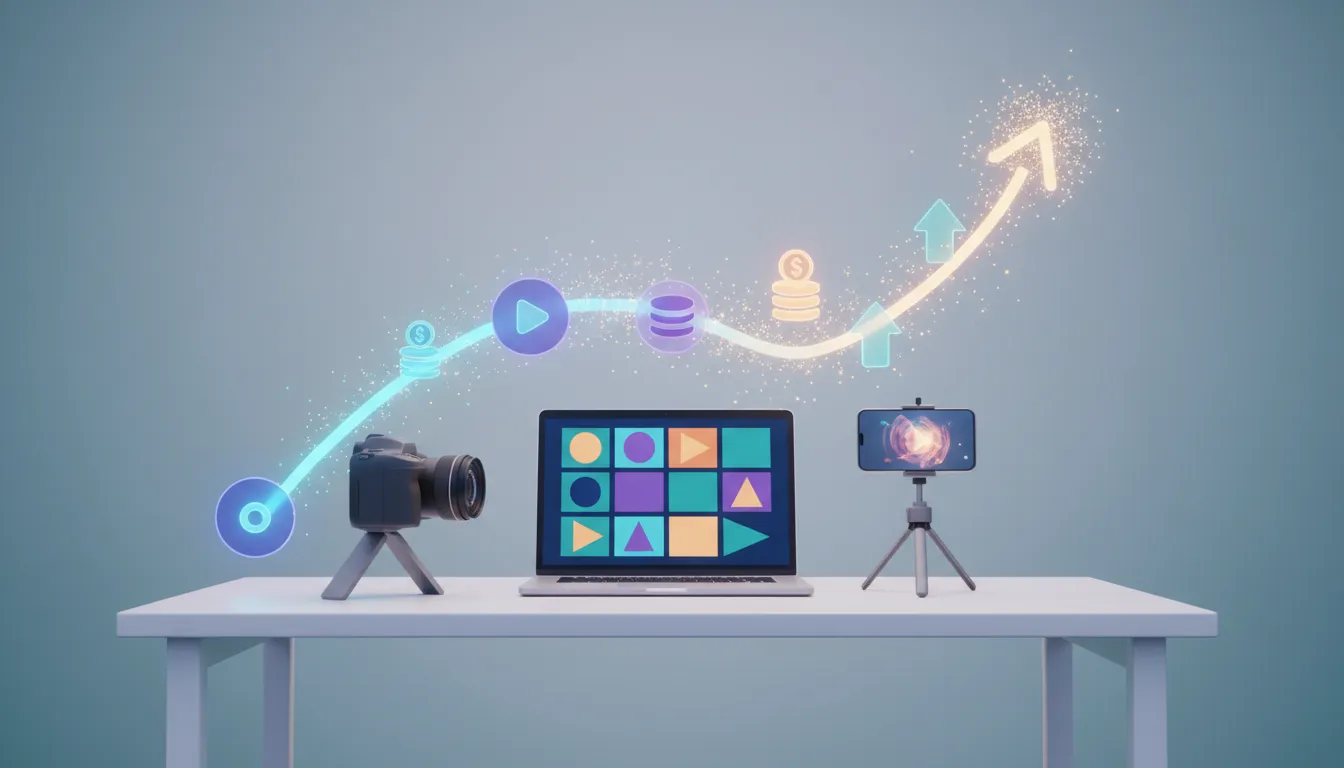
Growing on YouTube is not just about posting more. It is about consistently capturing attention, then monetizing that attention in ways that match your audience and your goals. This guide breaks down practical strategy for creators who want long-term growth, better performance from shorts-to-long-form, and a more resilient revenue mix in 2025.
Why “more subscribers” is not the only goal
A common trap is treating growth as a single metric. In reality, creators often have multiple outcomes they care about, such as:
- Audience growth (reach, watch time, returning viewers)
- Revenue growth (ads, sponsorships, products, consulting)
- Creative sustainability (a workload you can maintain)
- Brand strength (trust that carries across formats)
When you clarify your goal, you can choose the right “focus windows” for content, partnerships, and production decisions.
The attention-to-monetization model (use this to choose priorities)
Think of YouTube growth as two linked stages:
-
Capture attention with compelling storytelling and clear value.
-
Monetize attention by matching your content to the type of demand your audience and partners have.
If your videos do not consistently earn attention, monetization will be inconsistent. But if you chase monetization before you have attention locked in, you often end up with mismatched sponsorships, weak conversion, and churn.
Step 1: Do deep niche analysis before you brainstorm ideas
Strong ideas come from understanding where attention already lives in your niche and why people engage with it. Start with a “niche attention audit”:
- Where is the attention? Identify which parts of YouTube (home feed, search, shorts, long form) bring viewers in.
- What are they watching? Note recurring video topics, lengths, and formats.
- How do they respond? Review comments and look for repeated needs: education, entertainment, community, inspiration, controversy, and shortcuts.
- What is the value proposition? Write one sentence: “People watch my content because it helps them (blank).”
Then look for two outcomes:
- Similarities across top content in your niche (patterns worth copying).
- Open space where viewers are asking for something not consistently delivered.
Step 2: Understand your “addressable market ceiling”
Even strong creators hit a plateau if they do not expand what their niche can reach. A practical way to think about this is: if your content went viral, what portion of the niche would realistically watch?
You do not need perfect math. The point is to estimate the ceiling so you can ask better questions:
- Are viewers discovering me, or are they not finding me at all?
- Am I serving the whole niche, or only a small slice?
- Is there a category shift I can make without losing my identity?
Step 3: Use “identities, emotions, actions” to build better video concepts
When creators struggle to generate consistent ideas, it is usually because they are brainstorming topics without a clear audience promise. A useful framework:
1) Identities (who is watching?)
Segment your audience by “identity” instead of demographics. For example:
- Fans who already love the topic
- Curious newcomers
- People with deep knowledge or high standards
2) Emotions (what should they feel?)
Choose one primary emotional outcome per video concept, such as:
- Connected to a community
- Curious and surprised
- Educated and empowered
- Entertained and energized
3) Actions (what should they do next?)
Define the next action you want viewers to take:
- Subscribe for the next episode
- Comment their opinion or experience
- Watch a related video (series continuation)
- Try a checklist, template, or tutorial step
Once you write these down for each audience segment, you can generate title and thumbnail angles that match the promise, not just the topic.
Step 4: Create a “degree of difference” to protect your monetization
Brands and partners prefer creators they see as difficult to replace. That is not ego. It is a business reality: when your value is generic, you get compared and underpriced.
Increase your “degree of difference” by making your channel’s combination of:
- Format (how the story is told)
- Packaging (titles, thumbnails, pacing)
- Perspective (what you care about and how you interpret it)
- Audience trust (consistent quality and recurring themes)
Your goal is to become the creator people seek out for that specific experience.
Long-form and shorts in 2025: treat them like different apps
One of the biggest mistakes short-form creators make when transitioning to long form is assuming the audience automatically carries over. Shorts and long form behave differently. A conversion strategy works best when the “value proposition” stays consistent while the format adapts.
Keep the value proposition the same
If shorts deliver comedy, long form should also deliver comedy. If shorts deliver education, long form should also deliver education. Do not change what your channel promises; change how you deliver it.
Use long form as the hero, shorts as the trailer
A reliable approach is:
- Long form becomes the main content piece.
- Shorts become the “hook” that drives curiosity and sends people to the long video.
Pair shorts with a clear call to action that feels natural to the story, not bolted on.
Integrate the CTA early, not only at the end
Many viewers leave before the end of a short. If you want conversions, include a reason to continue within the first seconds. The CTA should feel like part of the narrative, not a separate “sales moment.”
Content trends to consider: longer episodes and more “real” on-camera presence
In 2025, several trends are gaining momentum:
- Longer episodes: More creators are building 20+ minute formats that perform well alongside connected TV behavior.
- Less “over-polished” packaging: Smarter thumbnails and less artificial facial expression can perform better when the content feels grounded.
- More authenticity: Audiences increasingly respond to creators who feel like real people, not distant brand mascots. This “FaceTime with a friend” vibe often improves engagement and trust.
You do not need to copy aesthetics. Instead, aim for a style that reinforces your content’s identity and credibility.
How to choose guests (and avoid making content dependent on them)
If your channel uses guests, it is possible to grow fast while still building long-term brand equity. The challenge is returning viewers: they may tune in for the guest once, but they stay because they trust the host and format.
A practical guest vetting checklist:
- Is there genuine excitement? The conversation should feel alive and not transactional.
- Is it a novel angle? Avoid topics already saturated unless you add a unique perspective.
- Can the channel work without the guest? Plan your channel identity so viewers trust the format even when the guest changes.
Monetization in 2025: build a mix, not a single bet
Ad revenue can be volatile. If a creator’s business depends too heavily on a single platform revenue stream, risk increases dramatically.
A more resilient model balances different monetization paths that match the type of attention you earn.
What to diversify into
- Brand relationships (sponsorships, partnerships, collaborations)
- Products (merch, digital products, memberships)
- Consulting or services (especially for B2B and niche education channels)
- Events (where relevant)
A practical revenue mix (starting point)
There is no universal percentage, but many successful creators aim for something like:
- 10-15% platform revenue (ads)
- majority brand relationships (sponsorships and partnerships)
- the remainder products and other services
Use this as a planning starting point, then adjust based on your audience needs and your content’s value proposition.
Sponsorships without chasing subscribers: how sponsorship targeting really works
Trying to “grow subscribers first” can be backwards if your niche already attracts purchasing intent. Sponsorships come from alignment between:
- Your audience
- The brand’s value and budget
- Your credibility in that niche
Use a value prop extension to build a brand target list
Write down three items:
- Your channel value proposition (what problem you solve)
- Your audience segment (who specifically benefits)
- Brands that provide the same value (who already competes for attention)
Then reach out with a relevant pitch that makes it easy for the brand to understand why your channel is a bridge to their audience.
Product strategy: don’t diversify too early, protect the hero
Creators often launch multiple products in parallel. That can dilute attention and slow the core engine that makes the channel work.
Two guardrails:
- Keep the hero product central (for many channels, the show or flagship content is the “engine”).
- Set realistic success criteria before launching a new series or product. Decide what “good” looks like.
Team building for YouTube: hire slowly, define the “heart” of production
Hiring is an investment with real costs. If a hire is wrong, it can disrupt your workflow and your creative quality.
Move from project-based to full-time
A low-risk process is:
- Start with a single video or short project window
- Extend to multiple videos over 1 to 3 months
- Only then consider a longer arrangement
Know what cannot be outsourced
Not everything should be delegated. Identify your “heart work,” often including the decisions that define your channel identity, such as:
- Packaging choices (titles and thumbnails)
- Creative direction and concept selection
- Editing and final narrative decisions (depending on the creator)
Some teams can outsource post-production, but creators often lose authenticity when the core framing and taste are removed.
Use end dates to reduce risk
Even within long-term projects, use clear end points. It makes evaluation easier and reduces long-term friction.
Idea generation with AI: speed up brainstorming, but protect quality
Idea volume is a real advantage. With AI-assisted workflows tailored to YouTube, creators can generate far more concept options, validate them quickly, and avoid wasting weeks on weak ideas.
Key idea: more ideas make you better, but only if you have a fast evaluation process.
- Use AI to generate a large pool of angles.
- Discard weak ideas quickly rather than polishing them.
- Practice producing 10 ideas per day as a “thinking muscle.”
AI can help you explore, but your channel identity decides what survives.
Fix low performance: create curiosity gaps between videos
If a “part two” performs worse, the issue is often not the topic. It is whether the viewer feels a reason to continue. Strong storytelling uses curiosity: present a question, then deliver an answer that creates the next question.
For titles and thumbnails, aim to:
- Set up information gaps viewers want resolved.
- Avoid flat statements that read like the story already ended.
- Keep continuity so the series feels like a journey, not a random re-upload.
Common mistakes that slow growth
- Changing the value proposition when moving from shorts to long form.
- Relying on ads alone and expanding costs too early.
- Over-diversifying products or series before the hero engine is stable.
- Guest content that overshadows the host, causing weak returning viewership.
- CTA placement that is too late, especially for short-form formats.
- Launches without success criteria (no definition of what “working” looks like).
Quick action plan for the next 30 days
- Run a niche attention audit: comments, watch patterns, and value propositions in your top competitor set.
- Write 3 audience segments and map identities, emotions, and actions for each.
- Produce a hero long-form plan and create 2 to 4 short-form trailers tied directly to long-form episodes.
- Improve packaging for curiosity: revise title and thumbnail angles to include an information gap.
- Build a brand target list using the value prop extension method.
- Define your success metrics: not only subscribers, but returning viewers, CTR targets, and conversion signals.
Conclusion: Win by combining storytelling, market fit, and monetization alignment
In 2025, the strongest YouTube growth strategies align three things: compelling storytelling that earns attention, a clear niche understanding that reveals opportunity, and monetization choices that fit your audience. When shorts-to-long-form transitions are treated as different formats, curiosity gaps are designed into the content, and revenue is diversified responsibly, growth becomes more predictable and sustainable.


