How to Turn a Small YouTube Channel into Real Income: A Practical Funnel for Content Creators

Mar 26, 2026 • 5 min read
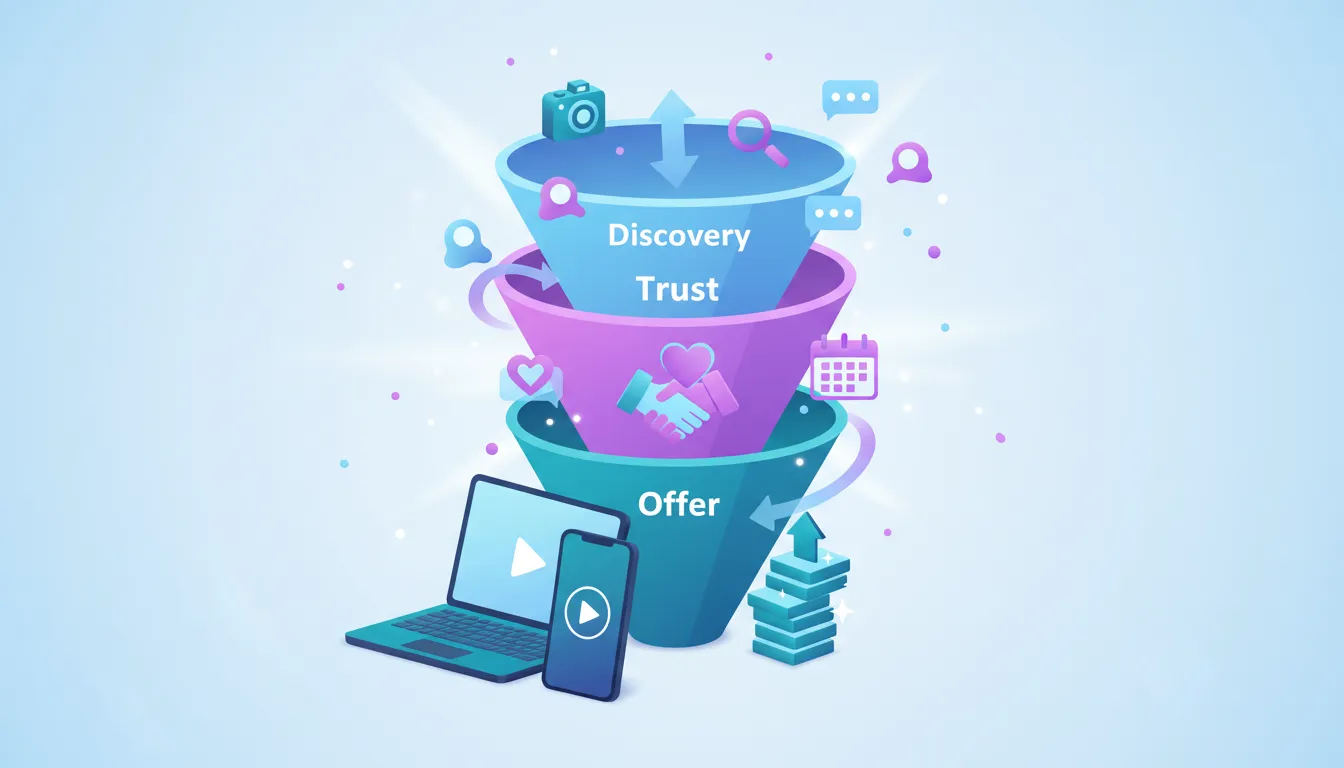
If you have a small YouTube channel, it is easy to feel stuck. You post consistently, the views are modest, and revenue feels far away. The reality is that income usually does not come from views alone. It comes from what you do after people discover you: building an audience you can reach, turning attention into trust, and matching an offer to real problems.
This guide shows a practical approach creators use to grow from a niche channel into a revenue engine using a content-to-community funnel. You will also find common mistakes to avoid, plus a checklist you can apply immediately.
Why small channels can still make real money
Many people assume you need tens of thousands of subscribers before monetization. In practice, smaller channels often win because:
- Your audience is more specific. A narrow niche usually means higher intent and clearer needs.
- Your conversion rate can be stronger. People who follow you are often there for a reason, not “accidentally.”
- You can build revenue without relying on one platform. Subscriptions are great, but email lists and communities let you reach people even when algorithms change.
- You can sell value before you sell big. Many creators earn early by offering a lead magnet, a low-ticket digital product, or a small coaching program.
The content-to-community funnel (simple, effective, repeatable)
A common pattern that works is:
- Publish content on YouTube to attract people searching for solutions.
- Capture attention with a lead magnet (free download, checklist, template, or mini training).
- Move them into a community where trust grows (often via Facebook group, Discord, email community, or membership).
- Run periodic offers such as a live workshop, a challenge, coaching, or a course.
- Use upsells and digital products to increase revenue without needing huge audiences.
Key idea: YouTube can bring discovery. Communities and email can drive conversion.
Step-by-step: Build the foundation in the right order
1) Choose a niche people can describe in one sentence
Your niche should create immediate clarity. If someone cannot explain who you help and what you help them achieve, it is harder to attract and convert.
Examples of clear niches:
- Business credit repair for founders with poor personal credit
- Meal prep for people managing diabetes
- Personal finance budgeting for early-career professionals
2) Create one lead magnet that solves a single problem
A lead magnet is not a “nice to have.” It is your first trust-building asset.
Good lead magnets are specific and immediately useful, such as:
- A checklist
- A template (proposal template, script, worksheet)
- A mini guide (how to start, how to avoid mistakes, how to prepare)
- A workbook
Practical tip: If you are building from scratch, make it “good enough.” You can improve it as you learn what people actually ask for.
3) Use landing pages to track intent
People should land on a page that matches what they want. Avoid sending every lead to a generic homepage.
For best results, create:
- A dedicated landing page for each content theme or offer
- A simple email capture form
- A clear promise of what they receive
4) Host a community where people can get help and share wins
Revenue improves when your audience feels supported and seen. A community works because it creates ongoing interaction, which increases:
- Trust (people see you show up)
- Momentum (people get feedback and encouragement)
- Social proof (wins inspire others)
For community structure, keep it simple:
- Welcome post that explains the purpose
- Clear norms for questions and feedback
- Weekly prompts (for struggles, wins, or lessons learned)
5) Sell value gently, then promote offers
Instead of hard selling on day one, use a soft sequence:
- Provide answers and resources in the community
- Ask what people want next
- When demand appears, introduce a relevant offer
Offers that often work for creators:
- Low-ticket digital products (templates, guides, libraries)
- Challenges or workshops (live training with actionable steps)
- Group coaching (coaching with a cohort)
- High-ticket services for advanced outcomes
Offer ladder: How to increase revenue without waiting for a huge audience
An offer ladder helps you monetize at multiple price points. A simple model:
Top of funnel (free)
- YouTube content
- Lead magnet download
- Community invitation
Middle (low-ticket)
- Digital download (for a quick win)
- Small workshop or challenge ticket
Core (mid-ticket)
- Group coaching cohort
- Guided program with weekly accountability
Advanced (high-ticket)
- 1:1 coaching or premium consulting
- Implementation support
- Done-with-you services
Why it works: people do not all want the same thing at the same time. Some will buy small first, then upgrade when they trust your process.
How to generate topics when your niche is technical
Creators in technical niches often struggle with topics because the subject matter is complex. The solution is to translate complexity into outcomes and pain points.
Use the “pain-to-plain” method
For each content idea, write:
- Pain: What is going wrong?
- Plain explanation: What does it mean in everyday terms?
- Path: What can they do next?
Example (credit niche):
- Pain: personal credit is damaged and funding is blocked
- Plain explanation: lenders see risk, so you get less approval and worse terms
- Path: improve the right credit signals and build business credit steps
Common mistakes that prevent monetization
- Waiting for perfection. Your first assets do not need to be flawless. They need to be consistent and improve over time.
- Publishing without a capture mechanism. If people never join an email list or community, you are relying entirely on algorithms.
- Creating offers no one asked for. Demand matters. Track questions and build offers around repeated requests.
- Only promoting one thing. Use an offer ladder so you can serve beginners and advanced buyers.
- Overthinking cadence. A simple publishing schedule beats sporadic bursts.
A simple 30-day execution plan
Week 1: Foundation
- Pick one niche angle for the next 4 weeks
- Create a single lead magnet (checklist, template, or workbook)
- Set up one landing page with email capture
- Create a community space with a welcome post and topic prompts
Week 2: Content that drives intent
- Publish 2 to 4 YouTube Shorts or videos targeting one problem
- Add a consistent call to action to get the lead magnet
- Start a community thread where members share their biggest obstacle
Week 3: Build proof through interaction
- Offer weekly Q&A or lesson posts in the community
- Collect “request data” (what people ask for repeatedly)
- Create a low-ticket digital product or workbook tied to the top question
Week 4: Run a small offer window
- Promote the low-ticket offer for a short period
- Host a live workshop or mini challenge
- Gather testimonials and outcomes
- Introduce the next step (group coaching, advanced program, or higher-ticket service)
Frequently asked questions
Do I need thousands of subscribers before I can sell?
No. You can sell with a smaller following if the audience is targeted and the offer solves a real problem. Conversion comes from alignment, not just reach.
What is the fastest way to earn money from YouTube?
Use YouTube for discovery, then move people into an owned channel (email list and community). Earn through a lead magnet, low-ticket product, and live offer window.
Is it better to sell on YouTube or in a community?
YouTube is great for attention and education. Communities are often better for conversion because trust builds through ongoing interaction. Many creators use both: content on YouTube, offers through the community.
How often should I run promotions?
Start with a predictable rhythm like one offer every 4 to 8 weeks. As you learn what works, you can tighten the schedule or expand it.
Key takeaway
Turning a small YouTube channel into real income is less about going viral and more about building a reliable funnel: content to trust to capture to community to offer. When you create helpful resources, listen to demand, and run short offer windows, monetization becomes repeatable.
If you want one guiding rule: publish consistently, capture attention, and build an audience you can reach.


