How to Grow on YouTube: Audience Research, Content Buckets, and a Winning Second-Channel Strategy

Mar 26, 2026 • 6 min read
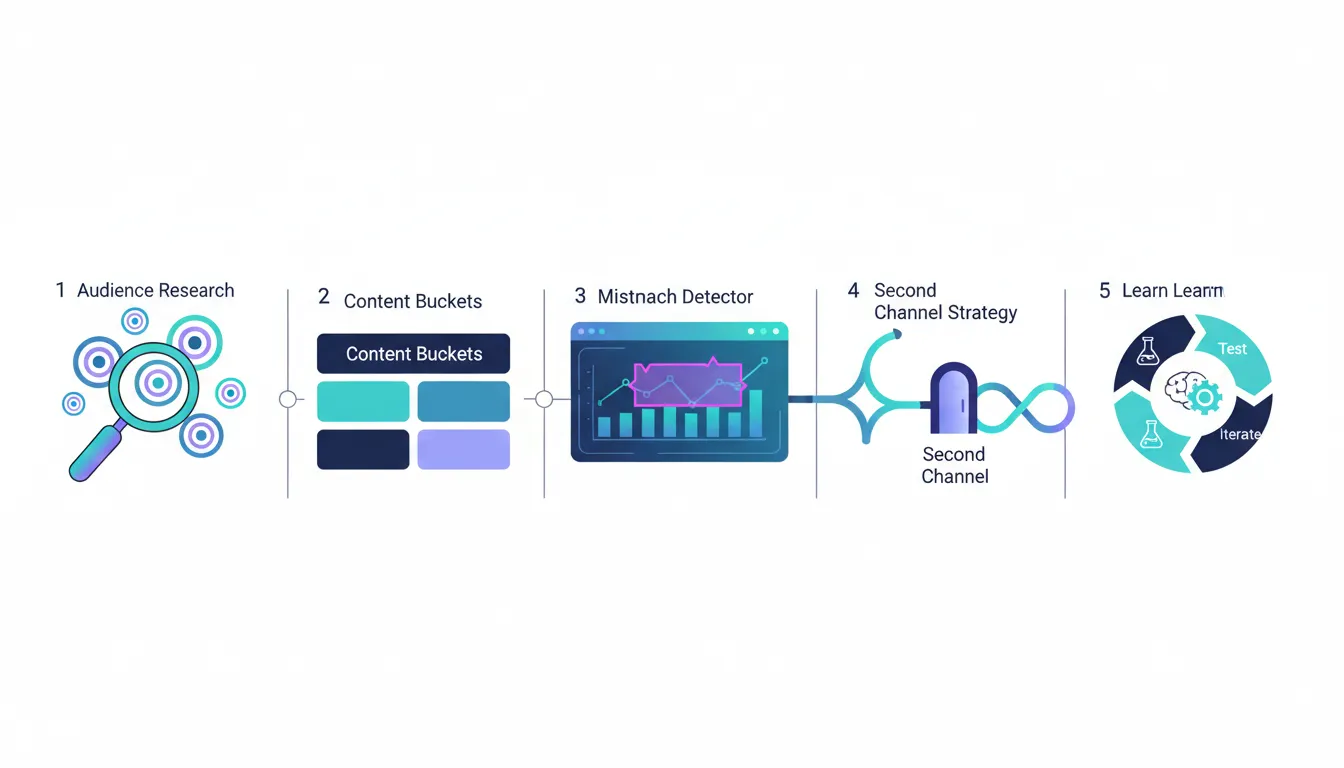
Growing on YouTube is not just about posting more often or improving thumbnails. Sustainable growth comes from a clear understanding of who your content is for, what they actually want to see next, and how YouTube interprets your catalog over time. This guide breaks down a practical approach to:
- Define your audience and channel goal
- Identify content buckets that drive growth
- Spot “audience mismatch” using analytics
- Launch a second channel without confusing the algorithm
- Use a testing cycle to make decisions with data
Why YouTube Growth Often Stalls (Even When Your Content Looks Good)
Many channels plateau because the channel does not stay consistent in the “job” it does for a specific audience. When your catalog mixes different audiences or different viewing intents, YouTube can struggle to learn who to recommend your content to.
Typical signs of this problem:
- Strong views on certain uploads, but inconsistent performance between posts
- New subscribers rising in bursts, then flattening
- Older videos still getting views, but pulling in a different audience than your goal
- Lower engagement from viewers in your target age group or device type
The fix is rarely “try harder.” It is usually “get clearer” about audience, content intent, and what YouTube should learn from your channel.
The Three Questions That Keep Your Channel Focused
If your content strategy feels chaotic, start with three fundamentals. They create clarity for your audience and for YouTube’s recommendation system.
1) What is your audience looking for?
Define the viewer’s core problem, curiosity, or desire. This goes beyond demographics like age or gender. Think intent:
- Do they want how-to instruction?
- Do they want entertainment or inspiration?
- Do they want product testing and comparisons?
- Do they want specific tools, tools reviews, or build challenges?
2) Who are you serving?
Create a concrete avatar for your primary viewer. Include:
- Who they are (basic profile)
- What they do (daily life context)
- What they believe and care about (preferences, priorities)
- How they consume (device type, where they spend time online)
- What they share (communities, forums, social platforms)
3) What is your channel’s goal?
Your goal determines what “success” looks like. Common goals include:
- Grow subscribers in a specific niche
- Increase watch time and returning viewers
- Build revenue through long-term views and product-driven content
- Establish a brand authority in a category
Without a goal, your content direction can drift, and the audience you attract might not match what you actually want to build.
Build “Content Buckets” Instead of Random Upload Ideas
Strong channels cluster their uploads into repeatable buckets. A bucket is a consistent viewing experience that attracts a specific type of viewer.
Example buckets for a maker or tools channel might include:
- Epic builds (high effort, big results, longer watch time)
- Trends and experiments (fast curiosity loop, “what is this?” viewing)
- Unboxings or “returned tools” (bargain discovery, anticipation)
- Tips and tricks (search-friendly education, evergreen learning)
Once you have buckets, you can analyze performance by intent, not just by views. This is where growth strategies become controllable.
How to Identify Audience Mismatch in Your Own Analytics
Audience mismatch happens when different upload buckets attract different viewer groups, and your channel tries to serve them all at once. You can detect it by comparing bucket performance across key analytics dimensions.
What to compare
- Age distribution by bucket
- Device type (mobile vs TV vs desktop)
- Traffic source (Browse, Search, Suggested)
- Geography if there are noticeable differences
- How performance changes over time between posting periods
What “mismatch” looks like in practice
- One bucket draws a younger audience, another draws an older audience.
- One bucket performs heavily on TV, another is mostly mobile.
- Older videos still get views, but those views do not align with growth goals.
If your top-growth bucket attracts a different audience than the rest of your catalog, the channel may be confusing YouTube. The result can be lower baseline views and harder-to-predict subscriber growth.
When You Should Consider a Second Channel
A second channel is not a gimmick. It is a structural decision that can help YouTube learn your audience more accurately by separating intents and reducing cross-audience noise.
Consider a second channel if:
- You have a proven bucket that consistently performs and has a distinct audience profile
- Your main channel has “muddying” content that slows learning (different intent, different viewers)
- Switching upload formats breaks momentum or causes long valleys between posts
- You want to double down on a specific viewer promise without confusing the channel
Do not consider a second channel if:
- You are launching it without knowing who it serves
- You are planning to re-upload the same content in the hope that it will “count differently”
- The “new channel” idea is only a random topic shift with no audience intent clarity
A Practical Second-Channel Launch Framework (Audience-First)
To launch effectively, treat the second channel as its own product. Start with the audience, then decide the content promise.
Step 1: Define the second channel goal
Pick what success means for the new channel:
- Enter a specific sub-niche
- Build watch time within a repeatable format
- Attract viewers most likely to convert through product interest or memberships
Step 2: Create a second-channel avatar
Build a clear “who” that matches the winning bucket:
- What do they care about?
- What do they already watch elsewhere?
- Which communities do they spend time in?
- How do they consume YouTube (including device patterns)?
Step 3: Find idea patterns that already work
Instead of inventing from scratch, study what is working in adjacent categories:
- Identify a format that has proven engagement
- Adapt it to your niche by changing the subject matter and examples
- Keep the structure consistent so the audience knows what to expect
Many top creators do this with thumbnails, video pacing, and content structure. The key is adaptation, not copy-pasting.
Step 4: Pre-queue content and publish consistently
When you launch a second channel, you want YouTube to detect repeatable demand quickly. That usually means:
- Have multiple uploads ready
- Post on a consistent schedule
- Avoid long gaps early on that slow learning
Consistency increases the chance that the algorithm can connect the channel to a stable viewer intent.
Step 5: Avoid “audience splitting” within the second channel
Don’t bring the old channel’s mixed-intent chaos into the new channel. Keep the new channel aligned to its purpose and audience promise.
If you do include new formats, treat them as tests, not as permanent direction changes.
The Content Testing Cycle: How to Make Decisions With Data
Stop guessing. Use a repeatable testing cycle so your strategy improves over time.
A simple testing rule
- Test each new bucket or format at least 3 times (not once).
- Space uploads 2 to 4 weeks apart (or whatever fits your workflow).
- Evaluate over a quarter (about 90 days) to see whether performance lifts baseline results.
This prevents overreacting to a single viral spike or a bad upload day.
What to measure beyond views
- Subscriber impact from each bucket
- Watch time and retention indicators
- Traffic sources to see whether YouTube is placing you in the right context
- Audience overlap if you track analytics by upload cluster
What to Do With Old “Wrong Audience” Videos
Old uploads can continue to attract viewers who do not align with your channel goal. Deleting videos can be tempting, but it is not always the best move.
Common approaches:
- Leave them live and let YouTube bury low-performing pieces naturally (especially if removal risks losing future search and suggested traffic).
- Create curated “supercut” style compilations on the second channel that focus on the winning intent.
- Reframe internal linking so the second channel becomes the primary destination for the specific audience.
Important: avoid re-uploading content in ways that break policies or confuse ownership. Compilations and new edits should be handled carefully and with originality.
Common Mistakes That Kill Growth
- Posting one-off ideas without a bucket plan. One viral video does not create a stable audience.
- Changing formats too frequently within the same channel identity.
- Ignoring device and traffic source patterns. Audience intent is often revealed through how people arrive and what devices they use.
- Launching a second channel without defining the avatar. A second channel needs a clear viewing promise.
- Copying titles and thumbnails only. If the structure and audience promise do not match, retention will fail.
Takeaways: A Repeatable Growth Plan
If you want a strategy that can be repeated and improved, follow this sequence:
- Define your channel goal and the audience intent it serves.
- Create content buckets based on repeatable viewing experiences.
- Analyze bucket performance across age, device type, and traffic source.
- Identify audience mismatch when different buckets attract different viewer groups.
- Double down with tests using a 3-try, 90-day evaluation cycle.
- Launch a second channel only when the audience promise is distinct, and keep it focused on that avatar.
When your channel (and second channel, if needed) delivers a consistent viewing promise to a specific audience, YouTube learns faster. That is what turns occasional spikes into reliable growth.


