Write YouTube Scripts in 2 Hours With This 3-Step AI Workflow

Most creators are using AI to write YouTube scripts in the worst possible way.
They open ChatGPT, type something like “write me a YouTube script about X,” and hope the machine magically spits out something sharp, original, and ready to record.
What comes back is usually bland, overexplained, and weirdly lifeless. Then comes the painful part: rewriting most of it by hand anyway.
If that sounds familiar, the problem is not AI. The problem is the workflow.
The fix is simple. Stop treating scriptwriting like one big task and start treating it like three separate jobs. Once you separate those jobs and use AI differently at each stage, the whole process gets faster and the result sounds far more like an actual human being.
The real reason AI scripts sound generic
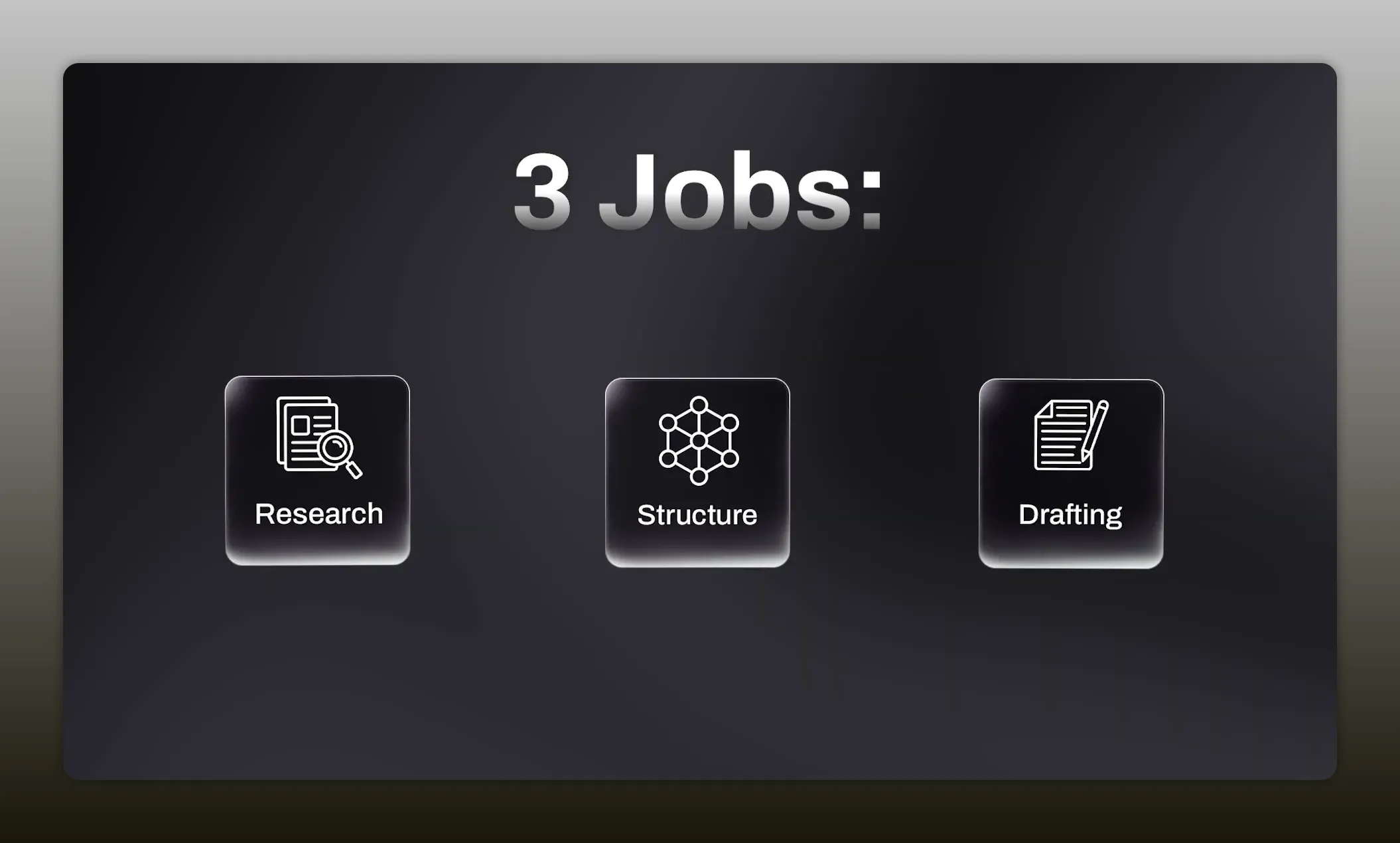
Writing a strong script is not one job. It is three:
- Research, where you find the angle and gather the raw material
- Structure, where you shape the flow so people keep listening
- Drafting, where the actual wording gets written in a voice that feels natural
The mistake most people make is asking AI to do all three at once, starting from a blank page and giving it almost no context.
Of course that fails.
If you give an AI model nothing specific about your take, your audience, your examples, or your style, it has only one thing it can do: average the internet. And the average of the internet is exactly what it sounds like. Safe. Flat. Generic.
So the goal is not to ask AI to invent your script from scratch. The goal is to make it useful at each stage while you stay in control.
Step 1: Stop asking AI to invent and make it organize instead
The first stage is where most people sabotage everything.
They sit down with a blank page and ask AI to come up with the idea, the angle, the examples, and the script all in one shot. That creates generic output because there is no real source material behind it.
A better move is to create your own raw material first.
Start with a messy brain dump
Before writing anything, do a five-minute brain dump on the topic.
Open a voice memo app, go for a short walk, and talk through everything you know. Include:
- Your opinions
- Your examples
- Your hot takes
- Common objections
- Questions people are likely to have
- Anything that feels half-formed but interesting
This should be messy. That is the point.
It does not need to sound polished. It does not even need to be well organized. You are not trying to create a script yet. You are trying to create source material that belongs to you.
Once you have that voice note, transcribe it with any transcription tool you already use. If you need one, Otter is a well-known option, and many creators also use built-in transcription tools inside notes apps or editing software.
Then give AI a narrower job
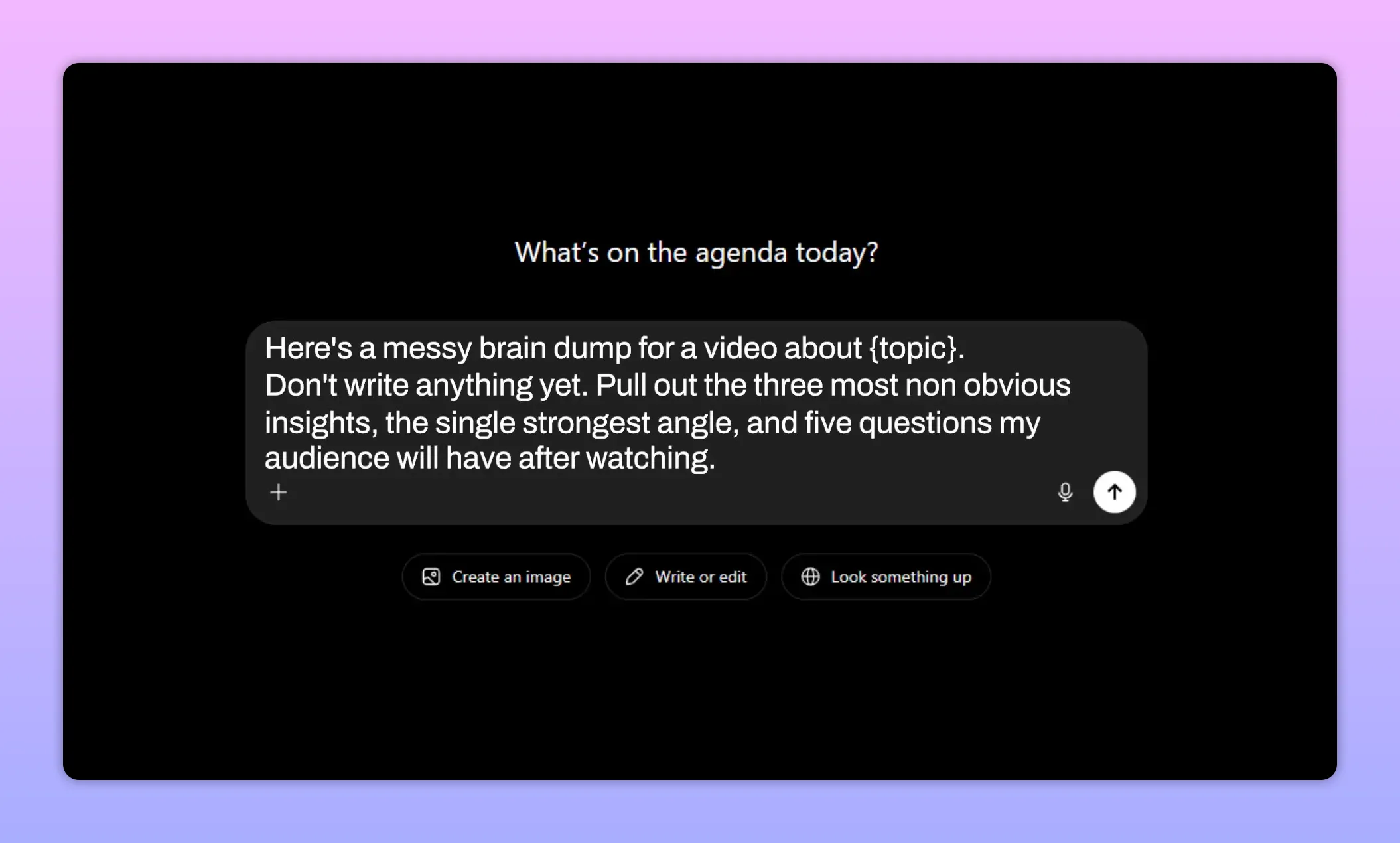
Take that messy transcription and paste it into your AI tool with a prompt built around organization, not full writing.
For example, ask it to:
- Pull out the three least obvious insights
- Identify the strongest angle
- List the questions your audience will still have afterward
That changes everything.
Now the AI is working from your brain, your examples, and your perspective. It is no longer producing the statistical average of whatever content already exists online.
Use competitor transcripts to find the gap
There is also a smart extension of this step if you want a stronger angle for search and discoverability.
Pull the transcripts from the top-ranking videos on your topic and compare them. Many tools can do this, and there are free browser-based options that make transcript extraction simple.
Then ask AI one question:
What did all of these videos fail to cover?
That missing piece is often the opportunity.
If the top results all repeat the same basic advice, the gap gives you a way to make something that stands beside them instead of disappearing behind them. For additional search context, it also helps to understand how YouTube thinks about relevance, satisfaction, and topic coverage. Google’s own guidance on YouTube recommendations and search is worth reviewing.
Step 2: Build the structure before writing a single sentence
This is the part that saves retention.
Most weak scripts do not fail because of awkward wording. They fail because the structure gives no reason to continue.
If the sequence is weak, no amount of polished sentence-level writing will save it.
So after step one, once you have your angle and your best insights, ask AI to help build a skeleton.
Not a script. A skeleton.
Ask for bullet points only
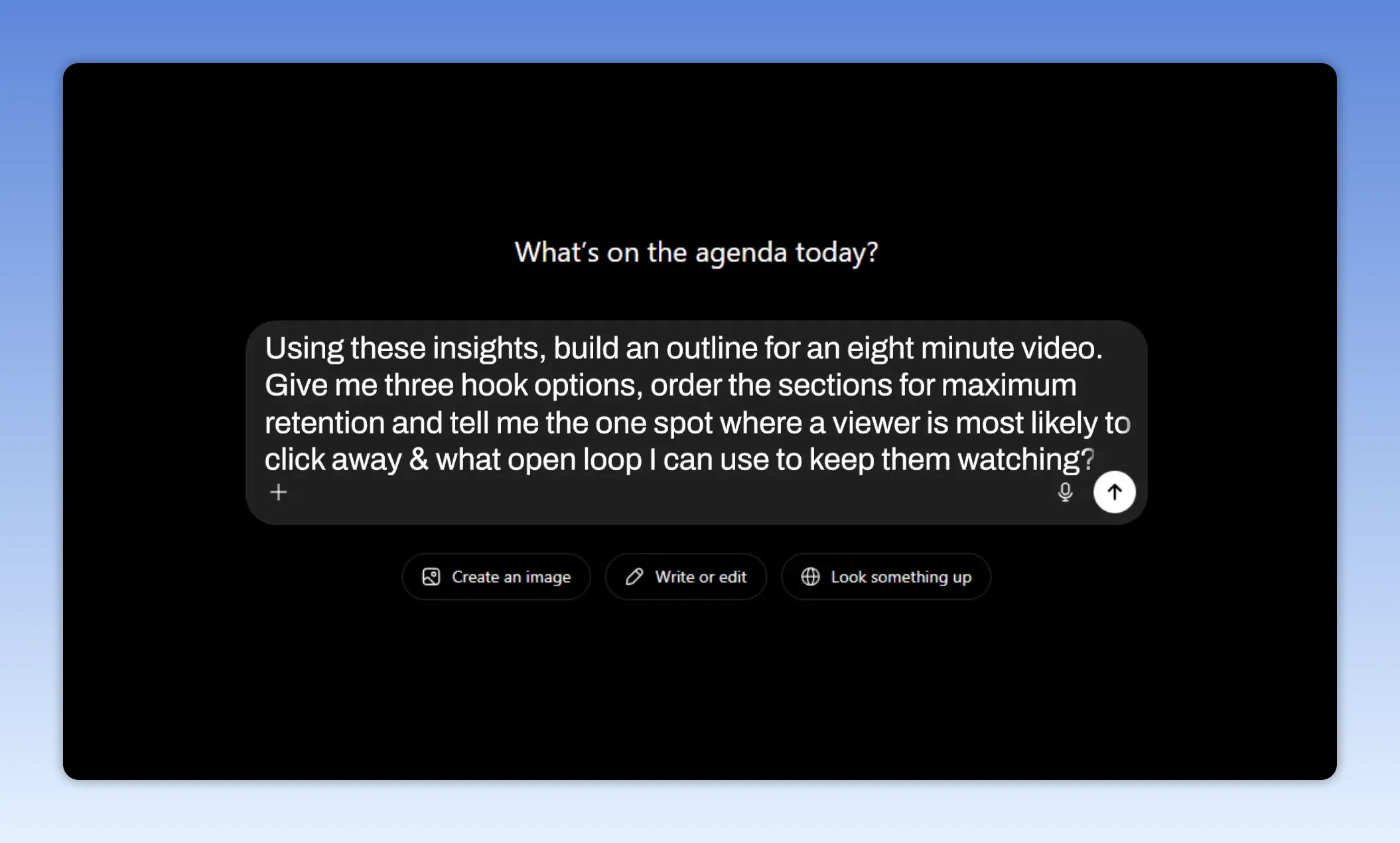
Give AI a prompt that asks for:
- An outline for a video of a specific length
- Three possible hooks
- A section order designed for retention
- The point where people are most likely to drop off
- An open loop that can carry them through that weak spot
There are two important ideas here.
1. Let AI propose, but you decide
If it gives you three hook options, great. Pick the one that actually fits your style and your point.
Do not assume the first suggestion is the right one just because it sounds polished. AI can generate options fast, but judgment is still your job.
This is the pattern that makes the whole system work:
- AI proposes
- You decide
2. Use open loops on purpose
An open loop is a question, claim, or unresolved point introduced early and paid off later.
It creates tension. It makes the middle of the script easier to carry because there is still something unresolved pulling the audience forward.
Think of it like stretching a rubber band between two moments in the script. You bring up something intriguing now, and that tension holds attention until you close the loop later.
That is especially useful in the “boring middle” where many videos lose momentum.
The rule that matters most: no prose yet
This step has one non-negotiable rule.
Do not let AI write full paragraphs yet.
Stick to bullet points only.
Why? Because the moment you see polished wording, you start getting attached to sentences. Then you stop fixing the sequence. And sequence matters more than wording at this stage.
Lock the skeleton first. Always.
Step 3: Draft in your voice, section by section
Now you can draft.
But this is where most AI-written scripts still go off the rails.
The issue usually is not the model itself. The issue is that creators let it write in its default voice.
You know the tone. Slightly too polished. Slightly too cheerful. A little corporate. A little overexplained. It sounds like a robot trying very hard to seem helpful.
If you want better output, give it something better to imitate.
Train the draft on your existing voice
Take two or three transcripts from your own past videos, ideally the ones that sound most like you on your best day.
Paste them into the AI tool and ask it to study things like:
- Your sentence length
- How you open sections
- Your recurring phrases
- Your humor or rhythm
- Your general tone and pacing
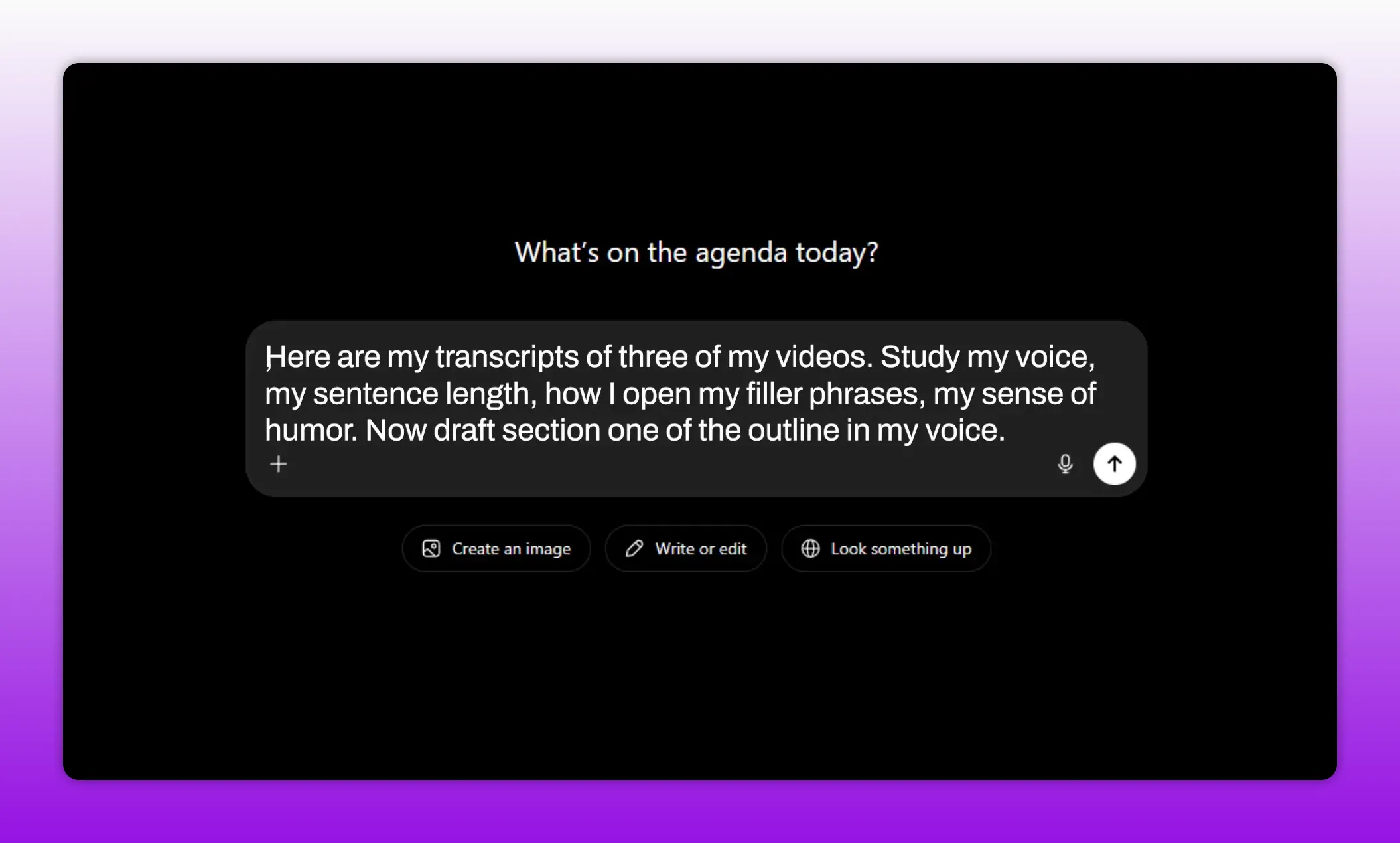
Then ask it to draft one section of the outline in that voice.
Not the full script. One section.
Why section-by-section drafting works better
AI tends to perform worse when asked for a giant block of writing all at once. Quality drops. The writing gets repetitive. The energy gets flatter.
Shorter, focused requests usually produce stronger output.
That means you draft one section at a time, review it, tweak it, then move to the next section.
This gives you better control over:
- Tone consistency
- Pacing
- Clarity
- Originality
Use the 80/20 approach
The best mindset here is simple:
AI does the first 80 percent. You do the final 20 percent.
That 80 percent removes the blank page, fills in the structure, and gives you a fast first pass in something close to your voice.
Your job is the final edit that makes it genuinely good.
You sharpen the opening. Cut the dead phrases. Replace weak examples. Punch up the transitions. Add the line only you would say.
That is the part that makes the script human.
And that is why this workflow can collapse a 15-hour scripting process into something closer to two hours. You are no longer wrestling with an empty document. You are editing a draft that already has shape.
The full 3-step AI scripting workflow
Here is the whole process in order:
- Brain dump: You create raw material through a quick voice-note dump. AI organizes your thoughts, identifies your angle, and surfaces your strongest insights.
- Skeleton: AI helps outline the video using bullet points only, with hook options, section order, and open loops designed to improve retention.
- Voice match: AI drafts each section in a style based on your past work, and you do the final edit that makes it actually sound like you.
The thread running through every step is the same:
You are the decision maker. AI is the assistant.
That is the difference between a useful workflow and a glorified slot machine.
What not to do
If you want this to work, avoid these common mistakes:
- Do not ask for a full script from a blank prompt
- Do not skip the angle-finding step
- Do not let prose start before structure is locked
- Do not ask for the entire draft in one massive block
- Do not accept AI suggestions without making choices
- Do not let the tool become the thinker while you become the cleanup crew
That last one matters most.
When people get soulless scripts, it is usually because they flipped the relationship. They handed over the decisions and kept only the editing burden.
That is how you end up spending hours polishing weak material instead of minutes refining something solid.
The bottom line
If your current AI scripting workflow feels disappointing, the solution is not more prompts, more tools, or more subscriptions.
It is a better sequence.
Use your own thinking as the raw material. Build the structure before the wording. Draft in your voice, one section at a time. Then do the human pass that gives the script personality.
That is how AI becomes genuinely useful for YouTube scriptwriting.
Not as a replacement for your judgment, but as a fast, tireless assistant that helps you get to the good part sooner.


