Is YouTube Shadow Banning AI Content? The New Rules and Guidelines Explained
The rumor is everywhere: YouTube is shadow banning AI content, demonetizing every AI channel, and wiping out creators who use generative tools.
That is not what is happening.
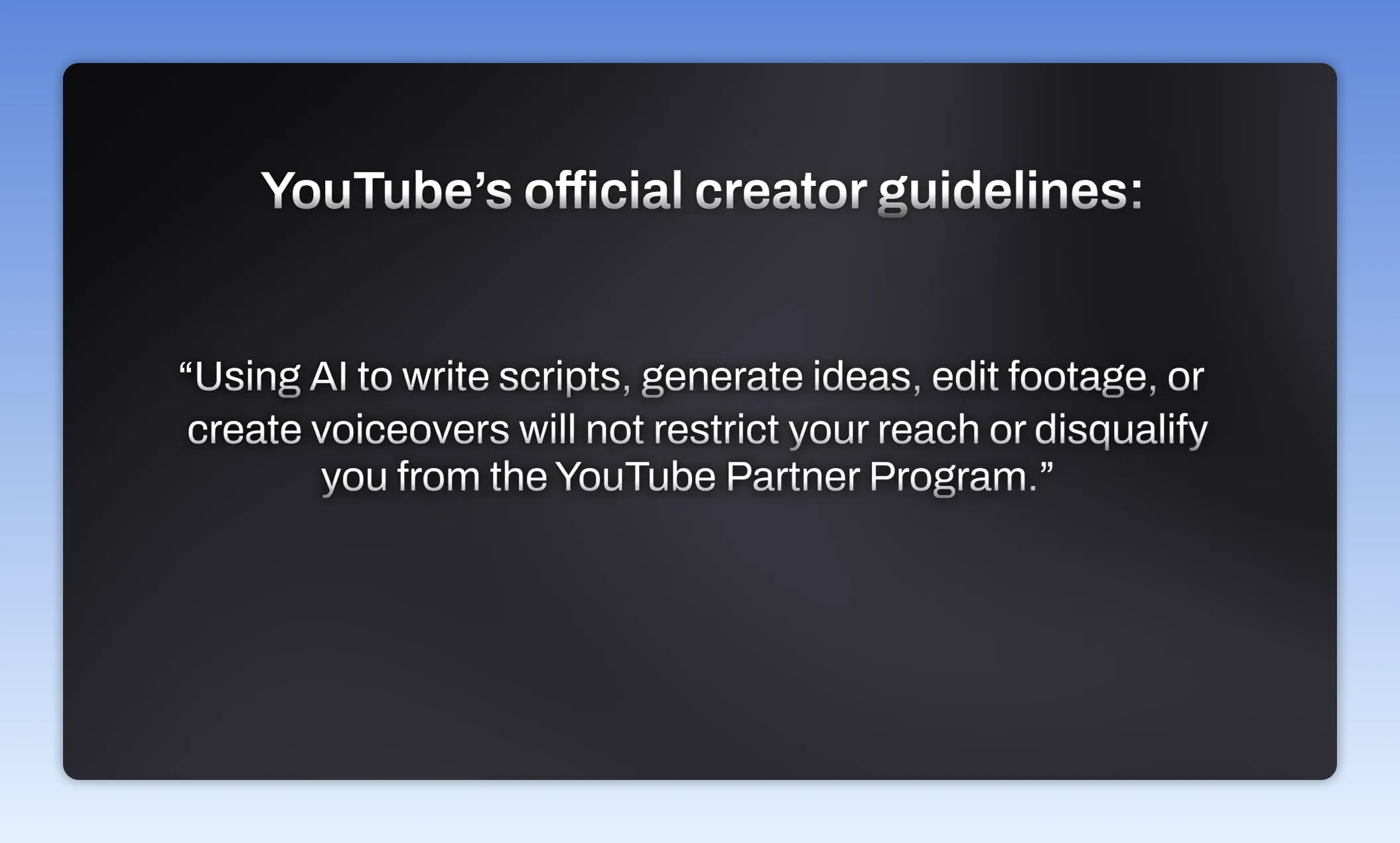
YouTube is not banning AI itself. You can use AI to write scripts, develop ideas, edit footage, create visuals, and even generate voiceovers without automatically losing reach or becoming ineligible for the YouTube Partner Program. The real shift is in how YouTube evaluates synthetic media, disclosure, reused content, and inauthentic channel behavior.
That distinction matters. Use AI as part of a real creative workflow and you are on far safer ground. Build a content factory that produces interchangeable, misleading, low effort uploads at scale and you are creating exactly the pattern YouTube is actively trying to remove.
The Biggest Myth: Using AI Does Not Automatically Hurt Your Channel
Generative AI is a tool, not a policy violation. YouTube’s creator guidance allows creators to use AI for practical production work, including writing, ideation, editing, and voice generation. Simply using those tools does not, by itself, restrict reach or disqualify a channel from monetization.
The problem begins when people confuse AI-assisted content with automated, repetitive, or deceptive content. Those are completely different things.
A creator using AI to speed up research, generate a first outline, or help produce visuals can still bring original judgment, analysis, pacing, editing, and a clear point of view to every upload. That is very different from publishing the same template again and again with a few nouns swapped out.
When YouTube Requires Synthetic Content Disclosure
The setting that causes the most confusion is YouTube Studio’s altered or synthetic content disclosure. Creators may need to disclose when a video contains realistic scenes or audio created or altered with AI.
In particular, disclosure becomes important when synthetic content could reasonably make someone believe that something real happened, that a real person said something they never said, or that altered footage is authentic.
This can include:
- Photorealistic deepfakes of real people
- AI-generated footage of realistic events
- Fake breaking-news scenes presented as genuine
- Synthetic audio that realistically imitates a real person
- Altered real-world footage that changes what appears to have happened
Many creators avoid checking the disclosure box because they think an AI label will suppress their video in the algorithm or reduce ad revenue. That is the wrong move. The disclosure adds a label in the description or player, but it is not presented as a reach penalty or monetization penalty.
The real risk is intentionally hiding realistic synthetic media. If YouTube’s systems or reviewers identify undisclosed content, the platform can apply the label itself. Repeated failures to disclose can lead to strikes or loss of monetization.
When in doubt, disclosure is the sensible choice. It protects the audience, makes your intent clear, and keeps the channel away from the deception category.
For the current platform language, review YouTube’s altered or synthetic content disclosure policy.
Why AI Channels Are Actually Getting Demonitized or Deleted
A wave of major channel removals has fueled the idea that YouTube is at war with artificial intelligence. But the common thread among the channels being targeted is not merely AI use. It is what YouTube identifies as inauthentic content and reused content.
The platform evaluates the channel as a whole, not just one upload in isolation. That means an upload pattern can be just as important as the contents of an individual file.
1. Mass-produced template channels
The first high-risk pattern is a channel network built around templates. Think five to ten channels publishing nearly identical formats, structures, and scripts, where the only meaningful change is the subject.
A typical example is an endlessly automated “10 facts about X” format. If each video follows the same rhythm, same script skeleton, same visual treatment, and same assembly-line process, it starts to look less like a channel with a point of view and more like a content factory.
Scale alone is not the problem. Consistent formatting is not automatically a problem either. The issue is when the content becomes so interchangeable that there is no obvious original contribution from one upload to the next.
2. AI slideshows with generic text-to-speech
Another risky format is the static AI slideshow: generated images fade in and out while a generic synthetic voice reads an unedited AI script.
There is little to no original commentary, no distinctive editing, no meaningful narrative structure, and no clear reason the content needed to be made by that specific channel. That is exactly where a video can fall into the low-value, reused-content territory.
AI-generated images or a synthetic voice are not inherently the issue. The issue is using them as a substitute for actual creative work.
3. Misleading metadata and synthetic realism
The third major danger zone is deception. This includes AI-generated fake movie trailers, fabricated breaking news, or deepfakes of public figures that are not clearly disclosed.
Titles, thumbnails, descriptions, and the video itself must not create a false impression that synthetic events are real. A realistic fake trailer cannot be marketed as an official release. A made-up news event cannot be packaged as actual reporting. And a public figure should not be made to appear to say or do something without clear disclosure.
The more realistic the synthetic media, the higher the responsibility to be transparent.
How YouTube Detects Risky AI Channel Patterns
Trying to beat the system by stripping file metadata or changing prompts misses the bigger picture. YouTube is not only looking at the video file. It can assess the behavior and consistency of the whole channel.
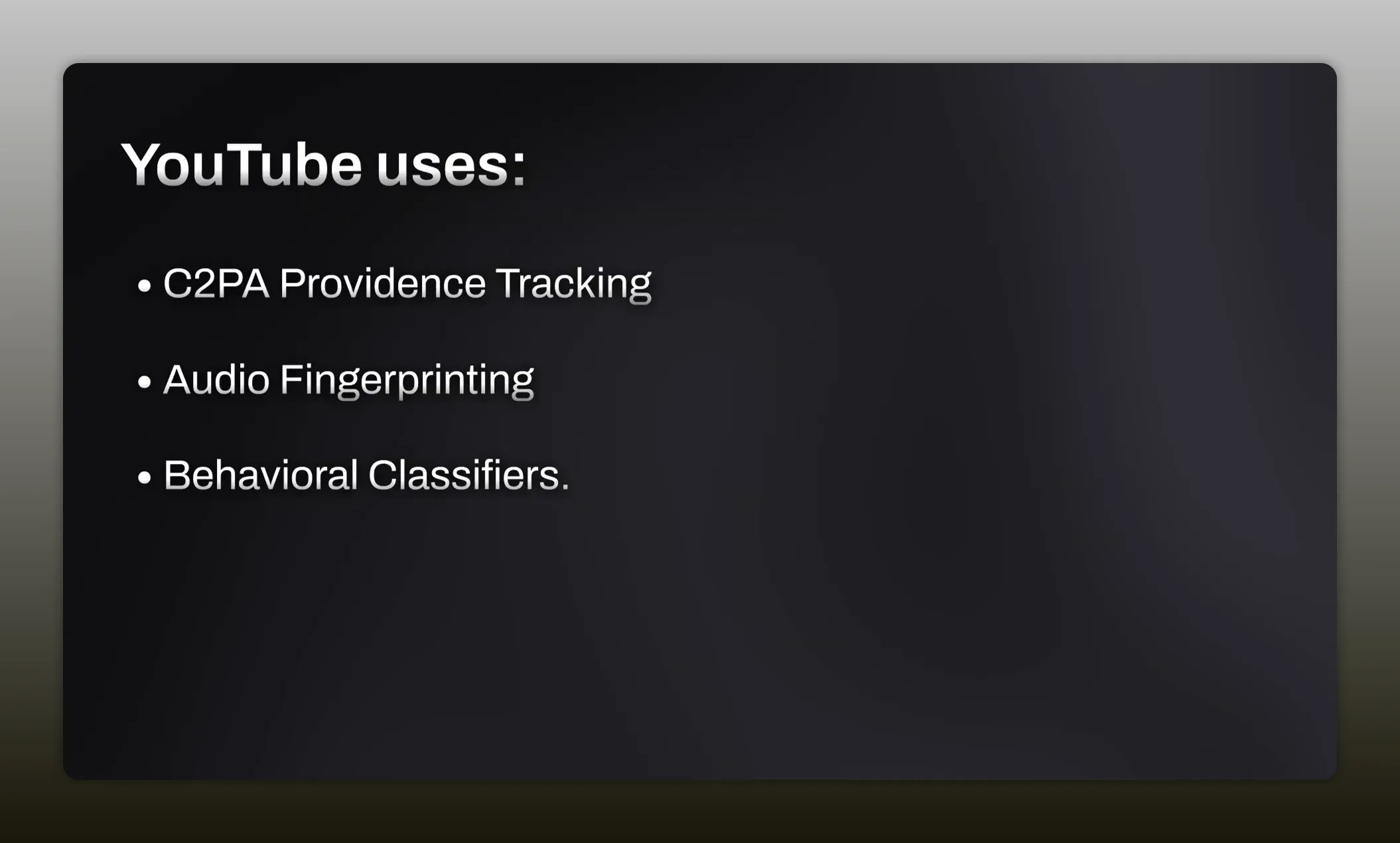
The signals described here include:
- C2PA provenance tracking
- Audio fingerprinting
- Behavioral classifiers
- Upload frequency
- Metadata consistency
- Audience retention patterns
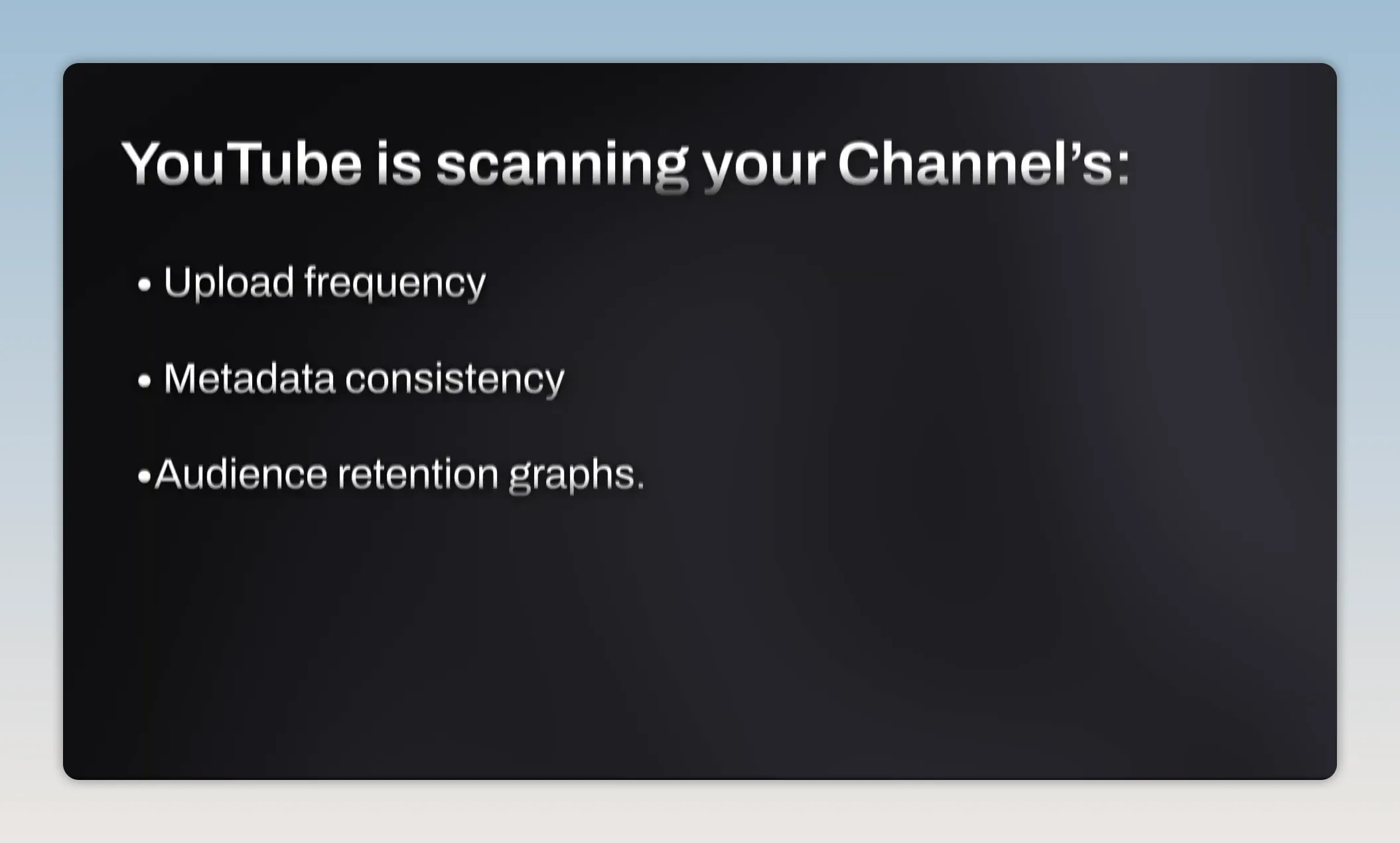
For example, a channel publishing three fully rendered videos every day with the same visual pacing, the same voice style, and nearly identical metadata can trigger concern regardless of whether the creator cleaned the file data.
That is the central point: YouTube can detect the pattern. A channel that feels mass-produced at every level is harder to defend than a channel that uses AI efficiently while still making deliberate creative decisions.
How to Use AI Safely on YouTube: Build a Hybrid Workflow
The safest approach is a hybrid workflow, not a fully automated one.
Use AI for the heavy lifting, then add the parts that require human perspective and intentional creative direction. AI is excellent for accelerating production, but it should not be the entire production process.
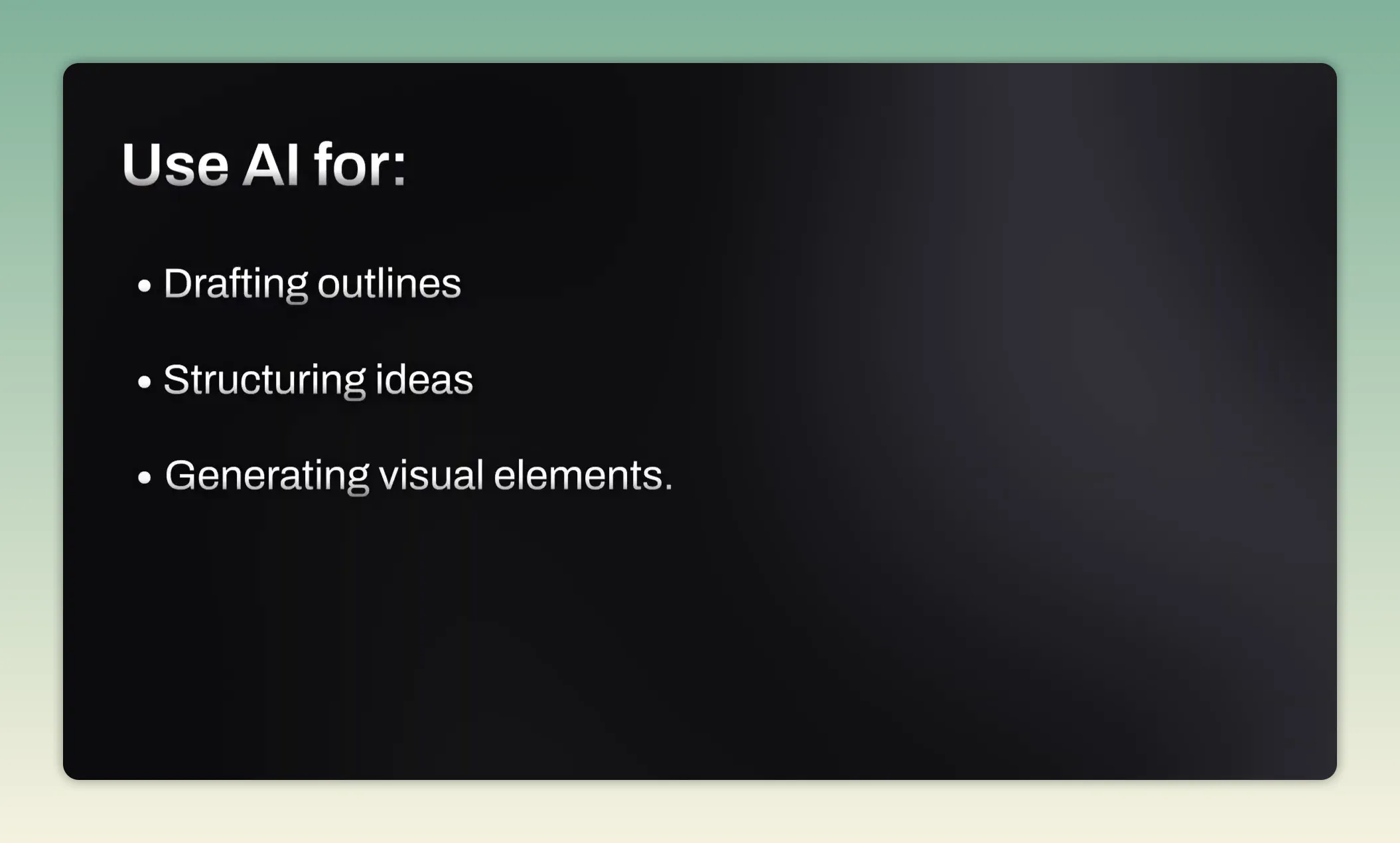
Use AI for these tasks
- Drafting outlines
- Structuring ideas
- Generating visual elements
- Creating a starting point for a script
- Helping organize a production workflow
Keep the final creative decisions human
The final assembly needs genuine value. That means refining the script until it has a specific perspective instead of publishing a raw prompt response. It means adjusting voiceover pacing so the delivery does not sound like a stock synthetic read. It means making visual cuts that support a distinctive narrative rather than relying on the same recycled rhythm every time.
A safer AI-assisted YouTube workflow looks like this:
- Start with a real editorial angle. Know what your channel adds that another generic upload does not.
- Use AI to accelerate the draft. Let it help with outlines, research organization, or visual concepts.
- Rewrite for a unique point of view. Add your own judgments, examples, structure, and conclusions.
- Edit with intention. Build pacing, visuals, and transitions around the story, not a template.
- Disclose realistic synthetic content. Especially when real people, events, or believable footage are involved.
- Audit your channel, not just one video. Look for repetition across uploads, titles, metadata, and visual style.
The Rule That Actually Matters
YouTube does not care that a tool helped you produce a video. It cares whether the finished content offers genuine value or whether it is just low-effort AI slop pushed out at scale.
So do not build around the question, “How much can I automate?” Build around the question, “What am I adding that makes this worth someone’s time?”
If the answer is original insight, purposeful storytelling, transparent use of realistic AI media, and a channel that does not look like an automated factory, AI can be a serious creative advantage rather than a channel risk.


